
A $21 billion New York chip story needs firmer ground
The headline ties Japan, New York and trade policy together, but the supporting numbers are thin.
 Rafael ImaiCompute, chips and power

A reported $21 billion Japanese plan for two New York chip factories is being framed as a product of Trump trade policy. The available data shows semiconductor producer prices rising, plus an electricity price and an employment figure, but not enough context to underwrite the story. India’s separate Strat360PL roadmap reinforces that chip investment is becoming local rather than generic.
A $21 billion figure is doing heavy lifting in a story about chips, New York and trade policy.
The central piece is a reported $21 billion plan for Japan to build two chip factories in New York. The same account ties that plan to a Trump trade deal. Those are the parts that would redraw capacity maps. They are also the parts that remain unconfirmed.
The more verifiable pieces are smaller: a semiconductor producer-price index, an electricity price and an information-sector employment figure. None of them proves the factory story, but together they show where the physical economy would have to show up.
The hard numbers are narrow
Semiconductor PPI rose from 28.472 in August 2026 to 28.801 in September 2026, a gain of 0.329 points, or about 1.2% in one month. That is a real movement, but it does not say whether the cause is stronger demand, higher input costs or supply-chain friction. A rising producer-price index can sit comfortably with either a boom or a squeeze.
A factory is not a line in a trade announcement; it is land, power, water, permits, hiring and suppliers.
The electricity price was 0.196 on 1 September, but without a unit, region or series it cannot be compared with the power cost a factory would face. For an industry that buys electricity in large blocks, the absence of that context matters.
Information-sector employment was 2,739 on 1 September. Again, the unit is missing. It could be thousands, millions or another measure. Until the unit is known, the number cannot be used to judge the labor market around a New York project.
A political headline is not a balance sheet
The investment narrative depends on two links: Japan, New York and two factories; and those factories to a Trump trade deal. Both are reported rather than established. If either link is weak, the story changes from a trade-policy win to a conventional site-selection proposal.
The India element is separate but related. Strat360PL published a report charting India’s path to a deeper electronics and semiconductor industry. It does not confirm the New York plan, but it shows why location matters: each jurisdiction is trying to assemble its own mix of incentives, skills and infrastructure.
For anyone tracking capacity, the mechanism is direct. A factory is not a line in a trade announcement; it is land, power, water, permits, hiring and suppliers. The September data gives a small window into three of those inputs: price, electricity and employment. It does not give the project.
The open question is verification
The useful comparison is between what moves and what is asserted. The semiconductor PPI moved in one month by a measurable amount. The electricity and employment figures exist, but they lack the context needed for a comparison. The $21 billion New York plan and its trade-deal link are asserted, not yet supported by those numbers.
That leaves the story in two parts. One part is a broad policy and industrial trend: the story links the United States, Japan and India in a push to make semiconductor capacity more local. The other part is a specific capital project that has not yet produced the kind of detail that lets a reader judge scale, timing or cost.
The next signal will not be another broad narrative. It will be whether the reported $21 billion becomes attached to a named builder, a site, a schedule and a power arrangement. Until then, the September PPI rise is the only firm number in the frame.
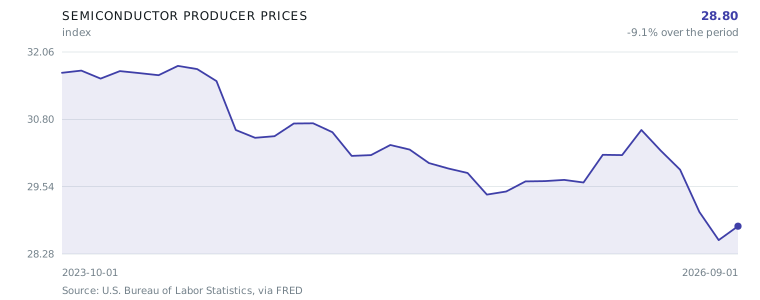
- 01Semiconductor PPI rose from 28.472 in August 2026 to 28.801 in September 2026.
- 02The electricity price was 0.196 on 1 September.
- 03Information-sector employment was 2,739 on 1 September.
- 04A reported $21 billion plan links Japan to two New York chip factories and a Trump trade deal.
- 05Strat360PL published a report charting India’s path to a deeper electronics and semiconductor industry.
Interpretation, not reporting. The facts above carry their tiers; this is one correspondent’s reading of them.
The useful signal here is not a $21 billion headline but the separation between announced geography and verified economics. I can trace a semiconductor price index, an electricity figure and an information-sector employment number, but the New York factory story remains a reported amount attached to a Trump trade deal. That gap matters because location-specific capacity is paid for in local power, labor and permits, not in broad industry optimism. If the New York investment is real, the September PPI rise could be read as demand-side strength; if it is not, the same number may simply be cost pressure. Strat360PL’s India report reinforces that policy is becoming a place-by-place project rather than a global wave. I would not treat the $21 billion as capacity until it is tied to something physical. The safer reading is that semiconductor investment is fragmenting into discrete political projects, each with its own execution risk.
— Rafael Imai
Every claim in this article, and what it rests on
We do not ask you to take our word for it. Each statement below carries its tier and its sources. Where sources disagree, you get both accounts and what would settle it.
Semiconductor PPI rose from 28.472 in August 2026 to 28.801 in September 2026.
The electricity price was 0.196 on 2026-09-01.
Information sector employment was 2,739 on 2026-09-01.
Japan is investing $21 billion to build two chip factories in New York.
The reported Japanese chip-factory investment is tied to a Trump trade deal.
Strat360PL published a report charting India's path to a deeper electronics and semiconductor industry.
The case against this story
Written by an adversarial reviewer, not the correspondent
The story's overall picture links a massive Japanese semiconductor investment in New York to Trump's trade policy, then bolsters that narrative with economic indicators. But the two central claims — the $21 billion investment and its attribution to a Trump trade deal — are both at the lowest confidence tier, meaning the core of the story is essentially unverified. Meanwhile, the quantitative data points meant to provide supporting context are either too vaguely specified (an electricity price with no series, region, or unit), ambiguously numbered (employment of 2,739 with no stated unit), or carrying decimal precision that does not match how the official statistical agency actually publishes the data (PPI to three decimal places). The India report by Strat360PL is bolted on without any clear connection to the U.S. investment narrative. Rising semiconductor PPI could just as easily signal cost inflation or supply-chain stress as it could signal healthy industry growth. The story assembles weakly sourced claims and imprecise data points into a confident-sounding narrative about trade-policy-driven industrial expansion, but the foundation does not support the structure built on it.
Who benefits from this framing: Trump and his political allies benefit directly from framing that credits his trade deals with attracting $21 billion in foreign semiconductor investment. New York state and local officials benefit from claims of major job-creating factory investment in their state. The semiconductor industry benefits from positive investment narratives that could support subsidies or favorable policy. Strat360PL benefits from visibility if its report is cited as part of a broader industry-growth story. A reader who believes this framing walks away thinking Trump-era trade policy is delivering concrete industrial investment, which serves a political narrative regardless of whether the underlying investment claim and its political attribution hold up.
Report an error in this article
Subscriptions open at launch
Future Systems Review will be a paid publication. Reading is free while we build the archive — leave an address and we will write to you once, when subscriptions open.