
AI agents pitch for retirement before clients are ready
High-trust services are testing autonomous tools while workers and savers say they are unprepared.
 Magnus EbbesenEnterprise adoption and technology policy

A reported AI wealth platform and a survey of retirement anxiety show vendors moving faster than users. The evidence is thin: one startup, broad legal assertions, online chatter and a single employment number. The missing proof is adoption, not sentiment.
A former top HSBC executive has launched a wealth-management platform run by a team of AI agents, and its founder has already set a billion-dollar valuation target, according to reports. The pitch arrives beside a quieter signal: more than half of Hong Kong’s working adults believe AI will make their retirement path more unpredictable than previous generations, while only 20% feel prepared for AI-driven disruption.
That gap is the story, not the launch. Professional services sell judgement, confidentiality and accountability. When an agent drafts advice, reviews contracts or shapes a savings plan, the institution still owns the client relationship and the regulatory exposure. The question is not whether the software can talk like an adviser; it is whether firms can supervise it, and whether clients will accept it when markets turn.
A single launch is not a sector-wide shift
The wealth-management example is concrete but narrow. Reports describe one startup, led by a former top HSBC executive, using a team of AI agents to do wealth-management work. The founder’s billion-dollar valuation target tells us about the company’s ambition, not about adoption across banks, law firms or advisory practices.
The real test will be mundane: contracts signed, compliance approvals granted, clients retained, and workers retrained.
In law, the descriptions are broader and thinner. AI is said to be changing lawyers’ work, billable hours and legal careers. That could mean anything from automated document review to a new billing spreadsheet. Without a named firm, a workflow change, or a budget line, it is closer to a truism than evidence of structural change. Earlier tools changed legal work; the description does not show how this is different.
Anxiety is not adoption
The Hong Kong survey adds a mood, not a market. More than half of working adults believe AI will make retirement less predictable than it was for earlier generations. Only 20% feel prepared for AI-driven disruption. Those are perceptions, measured at one point, not evidence that AI has already altered retirement outcomes, fees, advice quality or employment.
The distinction matters because retirement planning is slow and regulated. A saver’s outcome depends on contributions, employer policy, market returns, tax rules and decades of compounding. An anxious survey response does not show that agents are changing those inputs. It shows that people expect change and doubt their readiness. That is a marketing problem for providers and a policy problem for governments, but it is not proof of disruption.
The employment number is a single dot
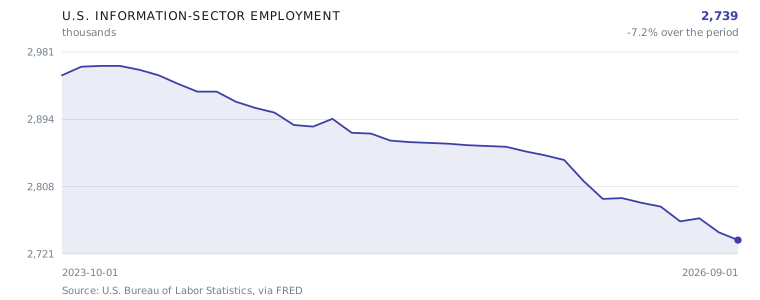
The data point is equally limited. The INFO_SECTOR_EMP instrument recorded 2,739 on 1 September 2026. That is a plain reading of the series, but the figure comes with no trend line, no comparison and no definition of what the instrument measures. It cannot confirm hiring, layoffs, productivity gains or AI-driven substitution.
The same caution applies to the programmer discussion. An India Times article reports online comments questioning whether programmers can build careers without relying on AI tools. Online debate can foreshadow change, but it can also amplify anxiety, fashion or a few loud users. A handful of comments is not a labour-market series.
Put together, the fragments do not yet form an industry transformation. They form an early test: one ambitious platform, a survey of unease, a broad legal assertion, online chatter and one isolated statistic. The real test will be mundane: contracts signed, compliance approvals granted, clients retained, and workers retrained. Until those appear, the safest reading is that AI agents are being marketed into high-trust sectors faster than the evidence shows they are being absorbed.
- 01A reported AI wealth-management venture was launched by a former top HSBC executive.
- 02The venture’s founder has set a billion-dollar valuation target.
- 03A survey found more than half of Hong Kong working adults expect AI to make retirement paths more unpredictable.
- 04The same survey found only 20% of workers feel prepared for AI-driven retirement disruption.
- 05INFO_SECTOR_EMP recorded 2,739 on 1 September 2026.
Interpretation, not reporting. The facts above carry their tiers; this is one correspondent’s reading of them.
The gap between ambition and readiness is the interesting part of this story, but not in the obvious way. I would not treat one AI-agent wealth platform as proof that finance is being rebuilt. I would treat it as a probe: if a firm lets agents touch client-facing advice, the bottleneck becomes supervision, audit and liability. The Hong Kong numbers matter because they show demand-side hesitation, not demand-side adoption. More than half expect unpredictability, while only 20% feel prepared; that is a trust deficit, not a revenue run-rate. The legal and programmer points are too vague to act on without procurement evidence. What would change my mind is boring: named firms moving agents from pilot to production, disclosed costs, retained clients, and employment data moving over several periods. Until then, I see a wave of pitches, not a wave of workflows.
— Magnus Ebbesen
Every claim in this article, and what it rests on
We do not ask you to take our word for it. Each statement below carries its tier and its sources. Where sources disagree, you get both accounts and what would settle it.
The INFO_SECTOR_EMP instrument recorded a value of 2,739 for 2026-09-01.
A former top HSBC executive launched a wealth-management platform powered by a team of AI agents.
The founder of the AI-driven wealth platform has set a billion-dollar valuation target.
More than half of Hong Kong’s working adults believe AI will make their retirement path more unpredictable than previous generations.
Only 20% of Hong Kong’s workers feel prepared for AI-driven retirement disruptions, according to a survey.
AI is changing lawyers’ work, billable hours, and legal careers.
An India Times article reports online discussion questioning whether programmers can build careers without relying on AI tools.
The case against this story
Written by an adversarial reviewer, not the correspondent
The story assembles loosely connected fragments to manufacture a picture of sweeping AI disruption across finance, law, programming, and retirement planning. But the wealth-management platform launch is one startup by one former executive — not an industry-wide transformation. The Hong Kong survey claims measure anxiety and perceptions, not actual AI-driven changes to retirement outcomes; people feeling unprepared does not establish that AI is disrupting anything. The claim about AI changing lawyers' work is so vague it could describe the introduction of email or Westlaw. The programmer career discussion is just internet chatter filtered through a media report, not evidence of a structural shift. And the employment data point is a single number stripped of context — no trend line, no comparison, no explanation of what it even measures. Together these pieces do not form a coherent picture of AI transformation. They form a patchwork of one startup's launch, opinion-survey feelings, a truism about legal work, online comments, and an isolated statistic — each presented as if it corroborates the others when none actually does.
Who benefits from this framing: The former HSBC executive's new AI wealth platform gains credibility, investor attention, and free publicity from a narrative that AI is transforming finance and retirement — directly supporting the billion-dollar valuation target. AI vendors and consultants across sectors benefit from urgency-driven adoption framed as inevitable disruption. Media outlets benefit from sensational AI stories that drive engagement. Financial advisors selling AI-powered retirement products benefit from survey findings that stoke anxiety about unpreparedness, turning fear into sales. And anyone advocating for AI investment benefits from a framing where the question is no longer whether AI will disrupt, but how fast — when the evidence presented does not actually establish disruption at all.
Report an error in this article
Subscriptions open at launch
Future Systems Review will be a paid publication. Reading is free while we build the archive — leave an address and we will write to you once, when subscriptions open.