
AI labs’ cheap shortcuts are becoming a diligence problem
Data from failed startups, memory-saving tricks and open-model trade-offs can change reliability, liability and valuation.
 Ines KovačFrontier models and AI agents

Cost-cutting in AI is being treated as routine procurement, but the evidence behind three current stories is thin. A reported DeepSeek memory-saving flaw, an anecdote about dead-startup data and open-model trade-offs each touch reliability, liability or valuation. The numbers attached to the file mark dates, not trends.
Three numbers are on the table: SEMI_PPI, a semiconductor price index, recorded 28.472 on 1 August; ELEC_PRICE recorded 0.196 the same day; INFO_SECTOR_EMP recorded 2,739 on 1 September. They are not comparable in units, and no earlier reading is attached. 28.472 is not high or low without a base; 0.196 is not cheap or expensive without a market; 2,739 is not growth or shrinkage without the prior month.
The diligence problem is not that these numbers explain AI costs. It is that the cost-cutting stories circulating around them are being asked to do explanatory work before they have been tested. A memory shortcut, a dead-startup dataset and an open-model debate each touch reliability, liability or valuation, but each arrives with a different level of proof.
The deeper issue is how a buyer prices what cannot yet be measured. If a shortcut saves money now but creates a failure mode later, the discount should show up in warranties, representations, insurance or valuation. At the moment, the evidence is too thin for that pricing.
A memory flaw is not yet a failure
SCMP reported new research identifying a potential flaw in the memory-saving technology underpinning DeepSeek’s models. The reported flaw may lead to inaccuracy in model performance. That wording matters. A potential flaw that may lead to inaccuracy is not a measured drop in accuracy, nor a demonstrated production failure.
The mechanism is easy to see. Memory-saving techniques reduce what a model must store or move in high-speed memory; if they approximate or drop information, outputs can shift. But the distance between “may” and “does” is where diligence lives. Until the effect is quantified, a buyer can only list it as a risk, not as a cost.
A potential flaw that may lead to inaccuracy is not a measured drop in accuracy, nor a demonstrated production failure.
A benchmark result, a deployment record and a revenue line are different objects. The SCMP-reported item is closest to the first: it points at a possible behaviour, not at a customer complaint, a broken service-level agreement or a lost contract.
One dead startup is not a data market
One account says AI labs are buying data from dead startups to train models. The example offered is Keelan Miskell, who, in the same account, wound down his crypto startup this year and initially did not think its data was worth much. That detail cuts against the idea of a hot secondary market. If the seller himself doubted the asset’s value, the story needs more than one anecdote to become a trend.
The diligence question is not whether a dataset can be bought cheaply. It is whether the buyer can show what the data contains, who created it, what rights transfer, and how it might bias or contaminate evaluation. Data provenance is a chain: collection, consent, cleaning, licensing and transfer. A dead startup can break that chain, because the people who knew how the data was gathered may be gone.
A bargain dataset can look like savings on the income statement and become a legal or reliability cost after deployment. That is the moment when cost-cutting stops being an engineering choice and becomes a valuation question.
Open models still carry unresolved trade-offs
MIT Technology Review has published material examining the benefits and risks of open AI models. The useful question is not “open or closed” as a slogan. It is who can inspect the weights, reproduce the failure, patch the model, or absorb liability when something goes wrong.
Openness can lower access costs and speed adoption. It can also make it harder to control downstream use or to assign responsibility when a model is modified. For policymakers and CTOs, the difference matters: an open model can be audited by outsiders, but it can also be forked beyond the original maintainer’s control.
The instruments alone will not settle that. They can show cost pressure; they cannot show whether the savings were bought with hidden risk.
The open question is whether investors and acquirers will demand evidence before they price these shortcuts, or only after a failure makes the discount visible.
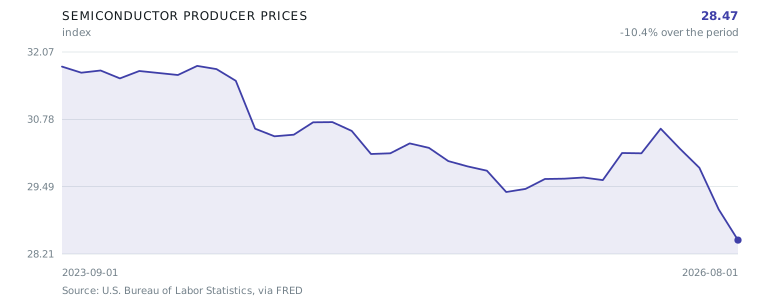
- 01SEMI_PPI recorded 28.472 on 1 August 2026.
- 02ELEC_PRICE recorded 0.196 on 1 August 2026.
- 03INFO_SECTOR_EMP recorded 2,739 on 1 September 2026.
- 04SCMP reported a potential flaw in DeepSeek’s memory-saving technology may lead to inaccuracy.
- 05MIT Technology Review has published material on the benefits and risks of open AI models.
Interpretation, not reporting. The facts above carry their tiers; this is one correspondent’s reading of them.
The diligence issue is not that any one shortcut is fatal; it is that each is being presented as ordinary procurement while its failure mode remains unpriced. I would separate the three strands. The DeepSeek item, as reported by SCMP, is a hypothesis: a potential flaw may lead to inaccuracy. That belongs in a risk register, not in a damages model, until someone measures the degradation. The dead-startup data story is weaker still: one anecdote about Keelan Miskell does not establish a market, and his initial doubt about the data’s value points the other way. MIT Technology Review’s open-model material is useful because it frames trade-offs rather than resolving them. The instrument readings—SEMI_PPI at 28.472, ELEC_PRICE at 0.196, INFO_SECTOR_EMP at 2,739—are markers without trends. I would watch for three things: quantified accuracy tests, data-rights documentation, and contract terms that allocate liability. If those appear, the shortcuts may be manageable. If they do not, the discount is the risk.
— Ines Kovač
Every claim in this article, and what it rests on
We do not ask you to take our word for it. Each statement below carries its tier and its sources. Where sources disagree, you get both accounts and what would settle it.
The SEMI_PPI instrument recorded a value of 28.472 for 2026-08-01.
The ELEC_PRICE instrument recorded a value of 0.196 for 2026-08-01.
The INFO_SECTOR_EMP instrument recorded a value of 2739 for 2026-09-01.
MIT Technology Review published material examining the benefits and risks of open AI models.
New research reported by SCMP identified a potential flaw in the memory-saving technology underpinning DeepSeek’s models.
The reported flaw in DeepSeek’s memory-saving technology may lead to inaccuracy in model performance.
AI labs are buying data from dead startups to train their models.
Keelan Miskell wound down his crypto startup this year and initially did not think its data was worth much.
The case against this story
Written by an adversarial reviewer, not the correspondent
The overall picture stitched together here is fragile on multiple fronts. The DeepSeek claims are hedged twice over — a 'potential flaw' that 'may lead to' inaccuracy — meaning no actual demonstrated performance degradation is asserted, only speculation about a possible one. The claim that AI labs are buying data from dead startups is a broad industry generalization that appears to rest on a single anecdote about one individual (Keelan Miskell) who 'initially did not think its data was worth much,' which actually cuts against the narrative: if even the seller didn't think the data was valuable, the premise that this represents a significant trend is weak. The MIT Technology Review claim is too vague to convey any substantive finding. Meanwhile, the three instrument readings (SEMI_PPI, ELEC_PRICE, INFO_SECTOR_EMP) are raw numbers with no stated connection to the AI-themed claims, making the overall story a loose bundle of unrelated items rather than a coherent picture. A reader cannot tell from these claims whether DeepSeek's flaw is serious or trivial, whether startup-data buying is widespread or isolated, or what MIT Technology Review actually concluded.
Who benefits from this framing: DeepSeek's commercial competitors — both closed-source and open-source labs — benefit from amplifying a narrative about a 'potential flaw' in DeepSeek's memory-saving technology, even when no actual performance degradation is demonstrated. Data brokers and intermediaries benefit from the framing that defunct startup data is valuable and actively sought by AI labs, since it inflates the perceived market value of datasets they might broker. Entities opposed to open AI model development benefit from the juxtaposition of a DeepSeek flaw story with a vague MIT Technology Review piece on 'risks of open AI models,' as the combined framing implies open models are inherently riskier without requiring anyone to prove it.
Report an error in this article
Subscriptions open at launch
Future Systems Review will be a paid publication. Reading is free while we build the archive — leave an address and we will write to you once, when subscriptions open.