
AI pause talk is louder than the meter data
Commentary on slowing or controlling AI is multiplying, but power prices, permits and control mechanisms remain thin.
 Rafael ImaiCompute, chips and power

Publications from MIT Technology Review, IEEE Spectrum, Townhall and Indiatimes show a split over pausing, controlling and trusting AI. The dispute is mostly rhetorical so far, with little evidence of regulatory action or measurable changes in deployment pace. The physical markers to watch are power contracts, interconnection queues and verifiable safety tests.
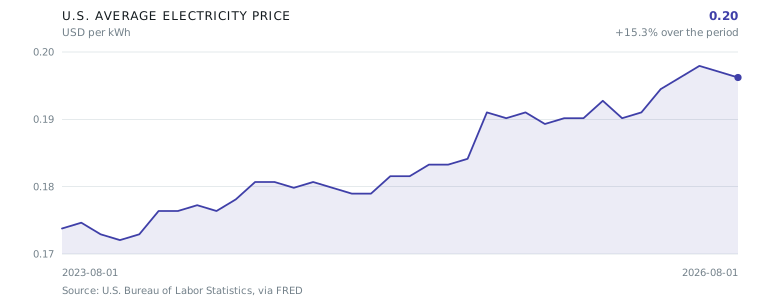
A single electricity-price figure — 0.196 on 1 August — is circulating beside a debate about whether AI should be slowed, controlled or trusted to refuse dangerous requests. The number has no region, unit or market attached. That absence is the point: the argument is currently louder than the meter data, contracts and permits that would make it binding.
The publications are easier to locate than the movement. MIT Technology Review published an article arguing that too much faith is being placed in AI’s ability to say no. IEEE Spectrum published '6 Guidelines for Governing AI'. Townhall published a column arguing that AI and data centers should be embraced rather than paused. Indiatimes published an article arguing that the real danger may be who controls AI rather than how smart it gets.
Those are distinct arguments, not one policy front. One treats refusal as a fragile safety mechanism. Another treats governance as a design problem. A third treats acceleration as the default, and a fourth moves the debate from model capability to ownership and control.
Refusal is not a fence
MIT Technology Review’s argument is that refusal is being asked to do too much. In that reading, a model’s no becomes a substitute for controls that can be inspected, enforced and appealed. The channel is trust: if a refusal is treated as the safety boundary, the boundary moves every time the model is changed.
A refusal is a software behavior, not a fence around a substation.
A refusal is a software behavior, not a fence around a substation. For a utility, a fence has a boundary, an inspector and a penalty. For a model, the boundary is statistical and can be tested by adversaries at near-zero marginal cost. That asymmetry matters for regulators: if refusals are treated as the main control, governance may lag the speed at which models are redeployed.
IEEE Spectrum’s guidelines suggest a different route: put the controls around the system, not only inside the model. The article’s existence does not show adoption. But it does show that the governance conversation is moving from abstract risk toward operating rules.
Pause talk meets the grid
The harder question is whether any of this changes capital. Townhall’s column argues for embracing AI and data centers rather than pausing them. That position points to the build-out side of the ledger, where projects are advanced through power requests, land deals and cooling contracts.
Indiatimes shifts the emphasis to control. If the issue is who controls AI, then a pause does not by itself answer the question. A paused model can still be owned, licensed, exported or nationalized; the fight moves to access rights, procurement and export controls.
One account says Anthropic CEO Dario Amodei joined a growing group of researchers calling for the AI industry to slow down. Another account questions the motivations of researchers making such calls. Those two readings cannot both be settled by the same thin public record. A named CEO can move markets if a statement is attached to spending, safety testing or deployment limits; without that, it remains rhetoric in a crowded field.
The electricity figure is a reminder of the physical layer. At 0.196, it is not possible to say whether power is cheap or dear, because there is no market, currency, contract type or customer class. A data center does not consume an abstraction. It consumes megawatt-hours, cooling water and grid interconnection queue time. If power prices rise in a constrained region, the cost lands on project economics; if they fall, they do not automatically create capacity.
What would change the picture
The evidence that would change the picture is procedural: a rule, a curtailment, a budget revision, a verifiable test.
Until then, the split is real as a contest of narratives. It is not yet visible in the physical bottlenecks that decide what gets built: transformers, switchgear, water rights and signed power contracts. The open question is whether governance will attach to those assets, or remain a debate about what a model might refuse to say.
- 01MIT Technology Review argues too much faith is being placed in AI's ability to say no.
- 02IEEE Spectrum published '6 Guidelines for Governing AI'.
- 03Townhall and Indiatimes published opposing arguments on pausing and control.
- 04One account says Dario Amodei joined researchers urging a slowdown; another questions their motivations.
- 05A recorded electricity price of 0.196 on 1 August lacks region, unit or market context.
Interpretation, not reporting. The facts above carry their tiers; this is one correspondent’s reading of them.
The real split is not pause versus build; it is whether governance can attach to physical infrastructure before model behavior outruns it. I would put less weight on slogans and more on where refusals are treated as a control. If MIT Technology Review is right that too much faith is being placed in AI’s ability to say no, then a refusal becomes a weak substitute for rules that can be inspected. The Amodei account may matter if it becomes a durable position, but the motivation questions make it a political signal rather than a measurable brake. The 0.196 electricity figure is telling only because it lacks a market; a data-center debate needs prices, not mood. If IEEE Spectrum’s guidelines are followed by concrete controls, that would be a real turn. Until then, I see a dispute over narratives, not yet over circuits.
— Rafael Imai
Every claim in this article, and what it rests on
We do not ask you to take our word for it. Each statement below carries its tier and its sources. Where sources disagree, you get both accounts and what would settle it.
MIT Technology Review published an article arguing that too much faith is being placed in AI's ability to say no.
IEEE Spectrum published an article titled '6 Guidelines for Governing AI'.
On 2026-08-01, the recorded electricity price was 0.196.
Townhall published a column arguing that AI and data centers should be embraced rather than paused.
Indiatimes published an article arguing that the real danger may be who controls AI rather than how smart it gets.
Anthropic CEO Dario Amodei joined a growing group of researchers calling for the AI industry to slow down.
Some observers have questioned the motivations of researchers calling for the AI industry to slow down.
The case against this story
Written by an adversarial reviewer, not the correspondent
The story's overall picture — that there is a significant AI slowdown movement with credible voices on multiple sides — is built from scattered opinion pieces and vague claims rather than substantive developments. The 'growing group of researchers' calling for slowdown is unspecified and already at the lowest confidence tier. 'Some observers have questioned the motivations' is an unfalsifiable 'some people say' construction. The publications cited (Townhall, Indiatimes) are opinion outlets, not primary sources of industry data. The electricity price data point is disconnected from the AI narrative and lacks basic context like region, unit, or market. The story appears to manufacture a narrative of high-stakes AI policy debate from commentary rather than evidence of actual industry changes, regulatory action, or measurable shifts in AI development pace.
Who benefits from this framing: If readers believe this framing, the primary beneficiaries are established AI companies like Anthropic, whose CEO's call to slow down is presented as part of a 'growing' movement — positioning the company as responsible while potentially slowing competitors. Regulatory advocates benefit from the impression of urgency and momentum for government intervention. Media outlets benefit from controversy-driven engagement. And those who already control AI infrastructure benefit from framing 'who controls AI' as the real danger, which can justify entrenching existing power rather than democratizing access.
Report an error in this article
Subscriptions open at launch
Future Systems Review will be a paid publication. Reading is free while we build the archive — leave an address and we will write to you once, when subscriptions open.