
AI research is becoming a control problem
The hard part is moving from capability demos to stable allocation under real constraints.
 Ines KovačFrontier models and AI agents

New work on multi-player bandits, attention formalisms, generative recommendation and flow matching keeps returning to the same constraint: convergence. The economic numbers attached to the story are thin, but the research direction is clear. The field is starting to sound like control engineering.
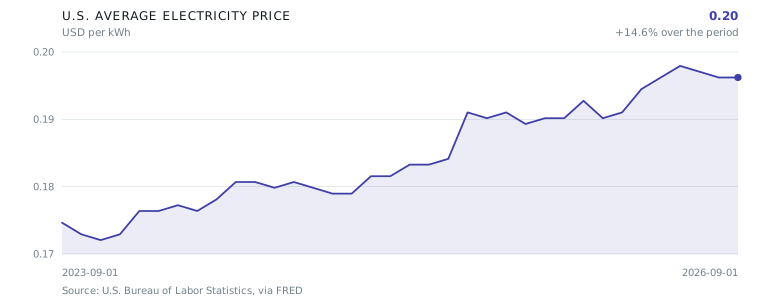
A number in the material is 2,739: information-sector employment in September 2026. It sits next to an electricity price of 0.196 for August and September 2026, and a semiconductor producer-price index of 28.472 in August 2026. None comes with a unit, market or base period, so the economic context is more placeholder than measurement.
The research is easier to read. A study approximates optimal policies in heterogeneous asynchronous multi-player bandits. That is a mouthful, but the operational issue is simple. When several agents choose actions at different speeds, the system can oscillate, starve some arms, or converge to a bad equilibrium. The paper treats policy design as a control problem: allocate attention, budget or actions so the group settles rather than thrashes.
The binding constraint is no longer what a model can represent, but whether it can be made to converge when many actors move at different speeds.
The same concern appears in the other work. Scaling flow matching, according to one paper, requires maintaining stability in training and integration. Generative recommendation models, another paper says, generate semantic item IDs autoregressively. The mechanism there is sequential: each token conditions the next, so small errors can compound. Stability is not a nice-to-have; it is the difference between a recommendation that converges to a useful item and one that drifts.

Papers are making stability arguments, not delivering settled facts
HASTE is described by its paper as introducing hierarchical and attribute-aware supervision for generative recommendation. Authors would say this gives the model a better training signal; a cautious reader would reply that the paper alone does not show the method works outside its own tests. The same caution applies to a free-energy formalism based on modern Hopfield models, which its paper says characterizes parameter regimes and critical thresholds in Transformer attention. The formalism may be useful, but the evidence here is the paper itself, not independent reproduction.
The technical idea worth holding onto is convergence. In control systems, a controller is not judged by its ideal response curve but by whether it reaches a stable state under disturbance. For AI deployment, the disturbance is ordinary: asynchronous users, competing objectives, limited compute, changing data. Stable allocation is the channel through which these constraints bite. If a model cannot allocate scarce resources—tokens, attention, actions, budget—without diverging, its benchmark score is a lab artifact. The binding constraint is no longer what a model can represent, but whether it can be made to converge when many actors move at different speeds.
The economic backdrop is thinner than the research signal
The macro figures do not yet carry the same specificity. Information-sector employment at 2,739 could mean thousands, millions or a narrow index, depending on the missing unit. An electricity price of 0.196 could be dollars per kilowatt-hour, euros per megawatt-hour scaled, or a local index. A semiconductor producer-price index of 28.472 could be a sub-index with an unknown base year. Without those anchors, the numbers cannot tell whether AI deployment is being constrained by labour, power or chip costs. The only firm comparison is that the electricity price is unchanged between August and September as stated. There is no prior month, base year or alternative series provided for comparison.
Watch the constraints, not the demos
The open question is whether these control-oriented methods survive contact with production. A bandit policy that approximates optimal behaviour in a heterogeneous asynchronous setting would matter if it reduces oscillation in live allocation. A free-energy account of attention would matter if it predicts failure regimes before they appear. A generative recommender would matter if its autoregressive item IDs stay coherent over long sessions. Until then, the tell is not that AI research is borrowing control language. It is that the field keeps asking where the system stops converging.
- 01A study approximates optimal policies in heterogeneous asynchronous multi-player bandits.
- 02Information-sector employment was 2,739 in September 2026.
- 03The electricity price was 0.196 in August 2026 and September 2026.
- 04The semiconductor producer price index was 28.472 in August 2026.
- 05HASTE is described by its paper as hierarchical and attribute-aware supervision for generative recommendation.
Interpretation, not reporting. The facts above carry their tiers; this is one correspondent’s reading of them.
The useful signal is methodological: AI research is starting to sound like control engineering. I would separate the papers’ ambitions from their evidence. The bandit work is the clearest example, because asynchronous multi-player allocation directly mirrors production systems where users, budgets and policies move at different speeds. HASTE and the Hopfield-based attention formalism are more tentative: each is presented by its own paper, and neither is independently settled here. The economic datapoints are even weaker, because 2,739, 0.196 and 28.472 arrive without units, markets or base periods. That does not make the story wrong; it makes the story early. If stability metrics start appearing alongside benchmark scores—oscillation, convergence time, failure thresholds—then this turn is real. If not, the control vocabulary may just be a new way to dress old failure modes.
— Ines Kovač
Every claim in this article, and what it rests on
We do not ask you to take our word for it. Each statement below carries its tier and its sources. Where sources disagree, you get both accounts and what would settle it.
A study approximates optimal policies in heterogeneous asynchronous multi-player bandits.
Information-sector employment was 2,739 in September 2026.
The electricity price was 0.196 in August 2026 and September 2026.
The semiconductor producer price index was 28.472 in August 2026.
HASTE introduces hierarchical and attribute-aware supervision for generative recommendation.
A free-energy formalism based on modern Hopfield models characterizes parameter regimes and critical thresholds in Transformer attention.
Generative recommendation models generate semantic item IDs autoregressively.
Scaling flow matching requires maintaining stability in training and integration.
The case against this story
Written by an adversarial reviewer, not the correspondent
The story's overall picture is one of crisp, settled facts across both cutting-edge ML research and current economic indicators. But the economic claims are the weakest link: three specific numerical values are presented at maximum confidence without units, base periods, or source attribution. An employment figure of '2,739' with no unit, an electricity price of '0.196' with no currency or market, and a semiconductor PPI of '28.472' that sits far below any standard index base are not tier-A datapoints—they are uncontextualized numbers that could mean almost anything or could be misreported. Meanwhile, the technical claims about HASTE and free-energy formalism are attributed to specific research outputs but presented as established fact rather than as findings awaiting community scrutiny. The entire story creates an illusion of precision: the reader walks away thinking that current economic conditions and frontier research results are more exactly known than the evidence actually supports.
Who benefits from this framing: If a reader believes this framing, the primary beneficiaries are parties who profit from presenting current conditions as precisely quantified and settled. For the economic claims, anyone who trades on or advocates policy based on perceived semiconductor pricing trends, electricity costs, or labor-market conditions benefits from the reader treating preliminary or uncontextualized numbers as hard facts. For the research claims, the authors and promoters of the named methods (HASTE, the Hopfield-attention formalism) benefit from having their contributions presented as verified findings rather than as individual research artifacts subject to ongoing evaluation. More broadly, any platform or publisher that packages disparate claims into a single confident narrative benefits from the reader's trust in the overall product, even when individual components lack the sourcing that the confidence tier implies.
Report an error in this article
Subscriptions open at launch
Future Systems Review will be a paid publication. Reading is free while we build the archive — leave an address and we will write to you once, when subscriptions open.