
AI’s 50% growth story meets a 5% governance signal
If AI’s upside is sold as huge, the market will ask who pays and what rules soften the blow.
 Ines KovačFrontier models and AI agents

A time.mk report says AI may increase the American economy by almost 50%, while also saying the labor market may bear the cost. Vesti.ru says Russia’s State Duma treats AI as unable to replace officials and deputies. A Hankyoreh report adds a governance signal: Anthropic is reported to have a 5% public-interest fund, and the report questions the motive.
A report about AI’s economic upside is now large enough to sound like a budget line: time.mk reports that AI may increase the American economy by almost 50%. The same report adds a less comfortable clause: the labor market may bear the cost of that increase.
Those two sentences belong together. If almost 50% of output can be added, somebody’s work is being changed, moved, or displaced. The question is no longer only whether the model can write code or summarize a brief. It is who absorbs the adjustment, and how fast.
Deputies are not volunteering
Vesti.ru reports that, in the Russian State Duma, AI is considered unable to replace government officials and deputies. That is a political statement, not a technical benchmark. It tells readers where one class of jobs is being placed: outside the automation perimeter, at least for now.
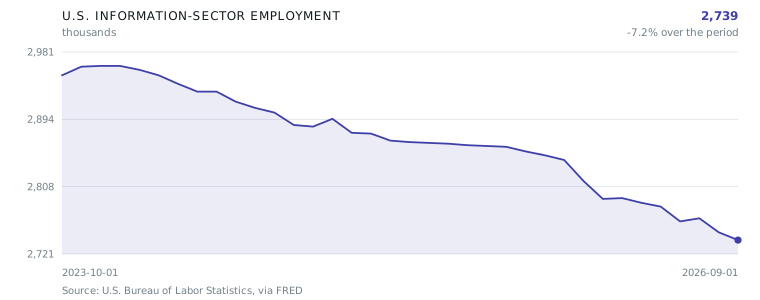
The instrument readings beside the story are quieter. The INFO_SECTOR_EMP series recorded 2,739 on 1 September. The ELEC_PRICE series recorded 0.196 on the same date. The SEMI_PPI series recorded 28.801. None of these numbers arrives with a prior month or a baseline, so each is a marker rather than a trend.
Still, they point at the same machinery. Employment, electricity and chip prices are the physical side of an AI boom. A model does not only need capital; it needs power, hardware and people to keep the service running.
The political system may protect its own roles while asking workers elsewhere to absorb the change.
A 5% answer to a 50% question
Anthropic enters the story through a governance signal. A Hankyoreh report says Anthropic is reported to have a 5% public-interest fund. The same report questions whether that move is intended to dilute concerns about AI threats.
The size matters because it is small next to the growth case. Five percent is not a macroeconomic offset to a projection of almost 50% expansion. It is a political and social buffer: a way to say that some of the upside will be directed toward public interest, if the reported structure exists as described.
But the motive question is not settled by the report. A fund can be a genuine constraint on profit, a public-relief valve, or both. The reader is left with a reported mechanism and a reported suspicion, not with a verified intent.
The cost is not a footnote
The strongest version of the AI story is not the 50% number alone. It is the pairing of that number with a labor-market warning. If output rises sharply while employment adjusts painfully, the political response may arrive before the economic statistics settle.
That is where the Duma statement becomes useful. It is easy to say AI cannot replace deputies. It is harder to say which tasks in ministries, companies, schools and call centers will be compressed first. The political system may protect its own roles while asking workers elsewhere to absorb the change.
The available data does not resolve this. It gives a reported growth projection, a reported labor cost, a reported fund and three instrument readings. The next test is whether any of those markers starts moving together: employment, power prices, chip costs and governance commitments in the same direction.
The missing pieces are ordinary. A direct statement from Anthropic would make the reported fund easier to price. A longer instrument series would show whether 2,739, 0.196 and 28.801 are turning points or noise. A labor-market study would say who bears the cost, and when.
The open question is whether the 5% device is the start of a rulebook, or a cushion for a 50% projection that has not yet met the payroll.
- 01time.mk reports AI may increase the American economy by almost 50%.
- 02The same report says the labor market may bear the cost.
- 03Vesti.ru says the Russian State Duma sees AI as unable to replace officials and deputies.
- 04Hankyoreh reports Anthropic is reported to have a 5% public-interest fund.
- 05INFO_SECTOR_EMP recorded 2,739 on 1 September.
Interpretation, not reporting. The facts above carry their tiers; this is one correspondent’s reading of them.
The governance story is not the fund’s size; it is the admission that a 50% upside cannot be sold without a cushion. I see the 5% figure as a political instrument, not a macroeconomic one. It is too small to offset an almost-50% growth projection, but large enough to signal that Anthropic, as reported by Hankyoreh, expects scrutiny. The Russian Duma item is the mirror image: deputies place their own jobs outside automation while the same global story warns that labor may pay for AI’s expansion. That combination tells me the binding constraint is technical less than social. If the fund is confirmed and tied to enforceable public-interest duties, it becomes a governance precedent. If it remains a reported gesture, it is reputation management. The instrument readings do not settle either question, because 2,739, 0.196 and 28.801 lack baselines. What I would watch is whether labor-market pain appears before the growth numbers do. That is when the 5% device stops being a footnote and becomes a bargaining chip.
— Ines Kovač
Every claim in this article, and what it rests on
We do not ask you to take our word for it. Each statement below carries its tier and its sources. Where sources disagree, you get both accounts and what would settle it.
A Vesti.ru report says that in the Russian State Duma, AI is considered unable to replace government officials and deputies.
The time.mk report says the labor market may bear the cost of that AI-driven economic increase.
The INFO_SECTOR_EMP instrument recorded a value of 2739 for 2026-09-01.
The ELEC_PRICE instrument recorded a value of 0.196 for 2026-09-01.
The SEMI_PPI instrument recorded a value of 28.801 for 2026-09-01.
A Hankyoreh report says Anthropic is reported to have a 5% public-interest fund.
The Hankyoreh report questions whether Anthropic’s reported 5% fund move is intended to dilute concerns about AI threats.
A time.mk report says AI may increase the American economy by almost 50%.
The case against this story
Written by an adversarial reviewer, not the correspondent
The overall picture stitched together here — Russian deputies dismissing AI replacement, Anthropic's public-interest fund, AI potentially boosting the US economy by nearly 50%, and supporting market data — creates a narrative of AI as simultaneously manageable, socially responsible, and economically transformative. But the seams show: the Anthropic fund claim rests on indirect attribution rather than a primary source; the Hankyoreh article's skepticism about that fund is itself an interpretation of editorial intent; the 50% economic-growth figure is hedged with 'may' and sourced to a Macedonian outlet reporting on what is presumably a US-based study; and the labor-market cost claim is the mirror image of the growth claim, presented as a caveat rather than an independently sourced finding. The instrument readings (employment, electricity price, semiconductor PPI) are presented without context — a reader cannot tell whether 2739 for info-sector employment or 0.196 for electricity prices is high, low, or anomalous without historical comparison. The story's coherence depends on the reader not asking which primary sources underlie each link in the chain.
Who benefits from this framing: Anthropic benefits directly: a narrative that foregrounds its 5% public-interest fund — even one filtered through indirect attribution and foreign-language press — positions the company as voluntarily addressing AI safety, potentially preempting regulatory pressure. Proponents of rapid AI deployment benefit from the 50% economic-growth figure circulating unchallenged, as it frames resistance to AI adoption as costly. The Russian State Duma benefits from a narrative that AI 'cannot replace' officials, reinforcing the legitimacy and irreplaceability of incumbent political structures. Readers who accept this framing without probing the underlying sources are left with a reassuring picture in which AI is powerful but governed, profitable but socially conscious, and economically inevitable — a picture that conveniently serves the most powerful actors in each domain.
Report an error in this article
Subscriptions open at launch
Future Systems Review will be a paid publication. Reading is free while we build the archive — leave an address and we will write to you once, when subscriptions open.