
AI’s office risk is now a training-cost question
The property impact of office automation turns on whether agents can learn affordably enough to matter.
 Ines KovačFrontier models and AI agents

Three instrument readings and a set of training arguments are being woven into a story about office demand in developed Asia-Pacific. The technical part says long-horizon agent training is expensive, but methods such as on-policy distillation and automated research may lower the cost. The macro part projects a five-percentage-point hit to office-demand growth, a number that sounds precise but is contested.
Three numbers are doing a lot of work in a new argument about artificial intelligence and office property: 2739, 0.196 and 28.472. On 1 September, the INFO_SECTOR_EMP instrument recorded 2739; the same day, ELEC_PRICE recorded 0.196. On 1 August, SEMI_PPI recorded 28.472. Without a longer series, these are levels, not trends.
They are being used to frame a bigger question: whether AI agents become cheap enough to displace office tasks, and what that would mean for developed Asia-Pacific office demand. The answer depends less on demos than on training economics.
Training agents is expensive until it isn't
Researchers describe the central bottleneck as long-horizon rollouts: an agent must try a multi-step task many times, fail, receive feedback and try again. That is compute-heavy because each attempt can involve many model calls. If that is right, agent adoption is not just a capability race; it is a cost-per-successful-task race.
Computer-use agents are said to have strong capabilities in reading screens and driving keyboard and mouse actions. Strong is doing heavy lifting here. Without a public benchmark, error rate, task suite or cost per completed task, the word tells us that someone is impressed, not that a procurement team can rely on it.
A chain that runs from token-level supervision to regional office vacancy must show every joint.
One proposed route is on-policy distillation, described as training a student model on its own rollouts while receiving token-level supervision from a teacher. The appeal is obvious: the student practises its own behaviour distribution rather than merely imitating static examples. But the method’s effectiveness, and its advantage over alternatives, has not been established here.
A second route is automated research: LLM agents that propose ideas, refine them iteratively and use scoring checks to separate useful directions from noise. This is a plausible laboratory tool, but “discover new ideas” is a high bar. A system that generates plausible hypotheses is not the same as one that produces durable, validated knowledge.
Five points is not mild
The economic step is harder. The projection says mild AI-related job displacement will trim five percentage points from office-demand growth in developed Asia-Pacific economies. Five points is a large move for a property market that normally grinds along at modest growth rates. Calling it mild while assigning a precise figure creates two problems at once.
First, the number needs a denominator and a baseline. Is the cut from expected demand growth over one year, five years, or a decade? Second, it needs a transmission mechanism. Does displacement reduce headcount, shrink floor area per worker, slow new leases, or push companies to sublet? Each channel operates on a different clock.
Sceptics can press further. The technical capabilities are described, not benchmarked. The training methods are plausible, not proven. The macro forecast is specific, but its inputs are not. A chain that runs from token-level supervision to regional office vacancy must show every joint.
Readings without a trend
The three instruments do not settle the argument. INFO_SECTOR_EMP at 2739 could point to information-sector employment, but the label alone does not reveal coverage, units or seasonal adjustment. ELEC_PRICE at 0.196 might matter because inference and training consume power, yet the currency, market and contract type are not visible. SEMI_PPI at 28.472 could be read as a semiconductor producer-price signal, but one month is a dot, not a direction.
For founders and investors, the practical question is narrower than the grand narrative. Can an agent complete a defined office workflow reliably, at a known cost, with audit trails and rollback? If yes, the office-demand story becomes real through leases, headcount plans and software budgets. If no, the property impact remains a scenario, not a forecast.
The next useful datapoint will not be a slogan. It will be a disclosed benchmark, a training-cost curve, or a landlord’s lease renewal file.
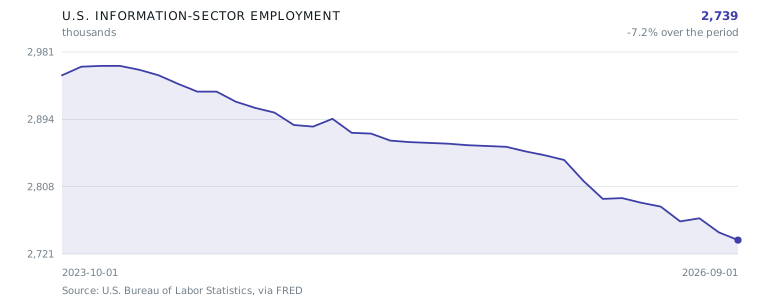
- 01INFO_SECTOR_EMP recorded 2739 on 1 September 2026.
- 02ELEC_PRICE recorded 0.196 on 1 September 2026.
- 03SEMI_PPI recorded 28.472 on 1 August 2026.
- 04Researchers describe long-horizon rollouts as the main cost bottleneck in training language agents.
- 05A projection says mild AI job displacement trims five percentage points from developed Asia-Pacific office-demand growth.
Interpretation, not reporting. The facts above carry their tiers; this is one correspondent’s reading of them.
The interesting part is not that AI might touch office work; it is that the property story now rests on training costs rather than model magic. I would treat the five-percentage-point office-demand figure as a scenario until it is tied to a baseline, a time horizon and a leasing channel. The instrument readings are too thin to do more than gesture at the inputs: one employment number, one electricity price and one semiconductor producer-price reading, all without trend or unit. If on-policy distillation and automated research eventually lower the cost of long-horizon rollouts, the risk becomes real in the dull way property markets feel risk: through headcount plans, lease renewals and space per worker. If those methods remain unproven, the strong-capability language is just demo gloss. I would watch for a disclosed benchmark and a cost curve before treating the office-demand projection as settled.
— Ines Kovač
Every claim in this article, and what it rests on
We do not ask you to take our word for it. Each statement below carries its tier and its sources. Where sources disagree, you get both accounts and what would settle it.
The INFO_SECTOR_EMP instrument recorded a value of 2739 for 2026-09-01.
The ELEC_PRICE instrument recorded a value of 0.196 for 2026-09-01.
The SEMI_PPI instrument recorded a value of 28.472 for 2026-08-01.
Training language agents is bottlenecked by the high cost of long-horizon rollouts.
Computer-use agents have demonstrated strong capabilities in interpreting screens and executing keyboard and mouse actions.
On-policy distillation trains a student model on its own rollouts with token-level supervision from a teacher.
Automated research with LLM agents can discover new ideas through iterative refinement and scored verifiers.
Mild AI-related job displacement is projected to trim five percentage points from office-demand growth in developed Asia-Pacific economies.
The case against this story
Written by an adversarial reviewer, not the correspondent
The overall story threads together AI-agent training costs, capability claims, and macroeconomic projections into a single narrative arc, but the seams are weak. The claim that computer-use agents have 'strong capabilities' is subjective and unbenchmarked—'strong' relative to what? The claim that on-policy distillation works with token-level supervision from a teacher is presented as settled method without evidence of its effectiveness or comparison to alternatives. The claim that automated research with LLM agents can 'discover new ideas' is aspirational rather than demonstrated. Most damagingly, the economic projection—that 'mild' AI-related job displacement will trim five percentage points from office-demand growth—is internally contradictory: five percentage points is not mild, and the specificity of the number is unsupported. The three instrument readings (INFO_SECTOR_EMP, ELEC_PRICE, SEMI_PPI) are presented as precise facts but without source datasets, time series, or methodology, making them impossible to verify. The story asks the reader to accept a chain of claims from technical AI capabilities to specific economic forecasts, but each link in the chain is either subjective, unverified, or contradictory.
Who benefits from this framing: If a reader accepts this framing, the primary beneficiaries are AI companies and their investors, who gain a narrative of inevitable progress and economic impact that supports valuations and funding rounds. Commercial real-estate analysts and firms selling office-demand forecasts benefit because the story lends urgency to their projections and services. Policymakers advocating for AI regulation—or for AI investment—can cite the economic-impact claim to justify their preferred stance. Finally, AI researchers seeking grants for agent-training infrastructure benefit from the claim that long-horizon rollouts are a costly bottleneck, as it directly argues for more resources.
Report an error in this article
Subscriptions open at launch
Future Systems Review will be a paid publication. Reading is free while we build the archive — leave an address and we will write to you once, when subscriptions open.