
AI serving’s next savings are in memory, not model size
Dynamic serving architectures could cut inference bills, but the evidence so far is thin.
 Ines KovačFrontier models and AI agents
Continuum Attention proposes replacing discrete key-value lookup with integration over a continuous, piecewise linear memory curve. The argument targets serving costs, using an electricity price of 0.196 and a semiconductor producer-price index of 28.472, but both lack units and comparisons. The key question is whether this elastic-memory approach beats existing cache-compression methods on real workloads.
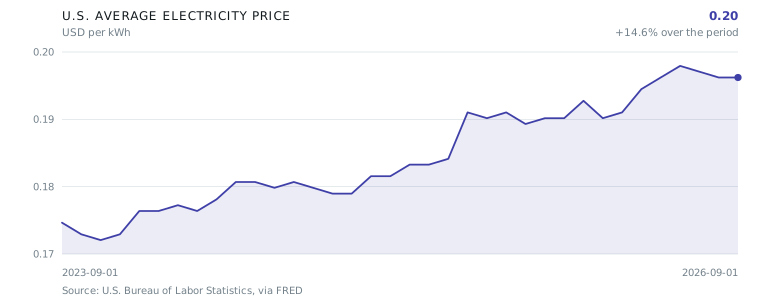
The pitch for Continuum Attention arrives with two numbers: an electricity price of 0.196 on 1 September 2026 and a semiconductor producer-price index of 28.472 on 1 August 2026. Neither comes with a unit, a region or a base period. Set beside no prior reading, 0.196 cannot say whether power for serving is getting dearer or cheaper; 28.472 cannot say whether chip prices are rising or falling.
Those numbers are meant to frame an argument about AI serving costs. The stronger version of that argument is not about raw model size. It says the next infrastructure savings will come from dynamic serving architectures—elastic memory and attention—rather than from fixed, larger models. The pitch is not really about a bigger model; it is about making the state inside serving cheaper to hold and read.
The cache is the bill
The technical starting point is familiar to anyone who has run long-context inference. In this description, long contexts enlarge key-value caches during generation. Enlarged caches are then said to increase memory use and raise attention costs while the model produces each next token. Compressing those caches is presented as a requirement to preserve information for unseen questions, which is a high bar and a hard one to test.

A key-value cache is not a mysterious database. It is the working state that lets a transformer reuse previously computed keys and values instead of recomputing them for every new token. When the context grows, that working state grows. The cost moves from a one-time prefill problem into a recurring generation problem, where memory bandwidth and attention overhead can dominate the bill.
The pitch is not really about a bigger model; it is about making the state inside serving cheaper to hold and read.
Continuum Attention proposes a different shape for that state. It replaces discrete key and value lookup with integration over a continuous, piecewise linear memory curve. Instead of asking which stored entry is closest, the system treats prior information as a curve that can be integrated over during generation. That is the elastic part: memory becomes a function, not just a list.
Snapshots cannot prove a trend
The economic scaffolding is thinner than the mechanism. An electricity price of 0.196 may matter to an inference operator, but without a currency, a market and a comparison it is a label, not evidence. A semiconductor producer-price index of 28.472 may point at hardware costs, but without a base period it cannot show whether accelerators, memory or packaging are becoming more expensive.
The gap matters because serving costs are not one number. They are energy, hardware depreciation, memory capacity, latency targets and engineering time. A method that reduces cache size but slows generation could lose money even if it saves memory. A method that preserves cache quality only on easy prompts could fail on the long, messy workloads that make elastic serving attractive in the first place.
There is also a competitive field. Cache compression can be pursued through several routes, including quantization, eviction policies, sparse attention, sliding-window attention and sub-linear attention. The case for Continuum Attention has to say whether its continuous curve beats those alternatives, matches them, or offers a different trade-off. Without head-to-head benchmarks, the idea remains a proposal rather than a procurement argument.
What would make it credible
The first test is workload selection. A serving architecture should be judged on ordinary traffic: multi-turn agents, retrieval-heavy queries, documents that arrive in uneven chunks, and conversations that must stay coherent over time. The second test is measurement: tokens per second, memory per session, tail latency, energy per query and accuracy after compression.
The fixed-size framing also needs care. Saying that transformer model families offer only a few fixed sizes risks overstating the constraint. Operators already choose among model sizes, quantization levels, context windows and batching strategies. The real question is whether Continuum Attention gives them a new knob that lowers cost without breaking reliability.
The open question is not whether the serving story identifies a real pressure point. It does: long contexts are described as enlarging key-value caches, and larger caches are said to raise memory and attention costs. The open question is whether integration over a continuous, piecewise linear memory curve can become a cheaper and safer default than the discrete caches already in production. Until that is shown on real workloads, the savings belong to the pitch deck, not the data centre.
- 01Continuum Attention replaces discrete key and value lookup with integration over a continuous, piecewise linear memory curve.
- 02The electricity price was 0.196 on 1 September 2026.
- 03The semiconductor producer-price index was 28.472 on 1 August 2026.
- 04The pitch says long contexts enlarge key-value caches and raise memory and attention costs during generation.
- 05The argument lacks units, regions, base periods and benchmark comparisons.
Interpretation, not reporting. The facts above carry their tiers; this is one correspondent’s reading of them.
The useful signal here is not a new model family but a change in where savings are sought: from parameter count to the moving state held during generation. I would treat Continuum Attention as a serving experiment, not a cost breakthrough. The electricity figure of 0.196 and semiconductor index of 28.472 are too bare to prove anything about inference economics; they become meaningful only when paired with units, a region, a base period and a workload. The harder test is technical. If integration over a continuous, piecewise linear memory curve can shrink cache pressure without hurting answers on ordinary queries, it deserves attention. If it merely trades discrete lookup for slower integration, the pitch collapses. I would watch for latency per token, memory per session and accuracy on long-context tasks, not for macro numbers. What would change my mind is a public comparison against existing cache-reduction methods on the same hardware and the same context lengths. Until then, this looks like an intriguing elastic-memory direction, not a proven infrastructure saving.
— Ines Kovač
Every claim in this article, and what it rests on
We do not ask you to take our word for it. Each statement below carries its tier and its sources. Where sources disagree, you get both accounts and what would settle it.
Continuum Attention replaces discrete key and value lookup with integration over a continuous, piecewise linear memory curve.
The electricity price was 0.196 on 2026-09-01.
The semiconductor producer price index was 28.472 on 2026-08-01.
Transformer model families offer only a few fixed sizes.
Long contexts enlarge key-value caches during generation.
Enlarged key-value caches increase memory use during generation.
Enlarged key-value caches increase attention costs during generation.
Compressing key-value caches must preserve information for unseen questions.
The case against this story
Written by an adversarial reviewer, not the correspondent
The story pairs well-established transformer mechanics—that long contexts enlarge key-value caches, raising memory and attention costs—with a specific proposed solution (Continuum Attention's continuous piecewise-linear memory curve) and two economic data points. But the economic data are single snapshots: an electricity price of 0.196 and a semiconductor PPI of 28.472. Neither has a unit, a region, a base period, or a comparison value, so they cannot establish trends or causal links to key-value cache costs. The key-value cache compression problem already has many competing solutions—quantization, eviction policies, sparse attention, sliding-window attention, sub-linear attention—and the story does not position Continuum Attention against any of them, making it impossible to judge whether the continuous-memory-curve approach is better, worse, or merely different. The claim that transformer families offer 'only a few fixed sizes' oversimplifies a landscape where families like Pythia, OPT, and BLOOM each offer eight or more size variants. The claim that compression 'must preserve information for unseen questions' is unfalsifiable as stated: any compression method can fail on some hypothetical future question, so the standard proves nothing specific. Without head-to-head benchmarks against existing cache-compression methods, the story is a solution looking for a problem it has not rigorously shown it solves better than alternatives.
Who benefits from this framing: The developers or promoters of Continuum Attention benefit directly: framing key-value cache costs as economically pressing (via the electricity and semiconductor price figures) and their method as the solution drives adoption, citations, and funding. If Continuum Attention is tied to a specific lab, startup, or product line, its commercial backers gain from the impression that existing alternatives are inadequate. Cloud providers and hardware vendors also benefit from the framing that inference compute costs are high and rising, which justifies premium pricing for long-context API services and memory-heavy accelerator hardware.
Report an error in this article
Subscriptions open at launch
Future Systems Review will be a paid publication. Reading is free while we build the archive — leave an address and we will write to you once, when subscriptions open.