
ASEAN’s investment story shifts from courting capital to keeping it
Policymakers are signalling that foreign capital must now pay for local resilience, not just arrive.
 Magnus EbbesenEnterprise adoption and technology policy

Bac Ninh’s authorities say the province has $49 billion in foreign direct investment capital and wants 700 supporting-industry firms by 2030. The IMF said Malaysia should broaden its tax base and improve subsidy targeting. Together, these moves point to a harder phase: keeping capital, building local suppliers and strengthening budgets.
Bac Ninh no longer wants to be known only as a place where foreign capital lands. Provincial authorities say the province has $49 billion in foreign direct investment capital, and they have set a target of 700 supporting-industry enterprises by 2030. They also report double-digit economic growth.
The pitch is changing. The old competition was simple: offer land, labour and tax holidays, then wait for factories to arrive. The newer version asks capital to stay, buy local parts, train workers and widen the tax base. That is a harder task, because it turns investment into industrial capacity rather than a one-off inflow.
Retention is harder than attraction
Bac Ninh’s numbers are big, but they are not fully legible. The province says it has $49 billion in foreign direct investment capital, yet the figure does not say whether that is cumulative stock or an annual flow. Double-digit growth is also unspecified: it could mean 10 percent or something much faster. The target of 700 supporting-industry enterprises by 2030 has no disclosed starting count, so the distance to the goal is unclear.
Those gaps matter because retention depends on depth. A province can attract assembly plants quickly, but supporting industries require years of supplier development, quality control and financing. If local firms cannot meet foreign buyers on price and reliability, the capital will keep its supply chains outside the province.
The hard part is not getting capital to arrive; it is making that capital pay for local skills, suppliers and budgets.
The risk is that targets substitute for the slower work of building firms. A headline number can be announced; a supplier cannot.
Budgets are becoming the incentive
The fiscal side is moving in the same direction. The IMF said Malaysia should broaden its tax base and improve subsidy targeting to withstand future shocks. That is not a slogan; it is a warning that generous incentives and blunt subsidies can leave governments exposed when growth slows or commodity prices move.
The Party Executive Committee issued a conclusion covering 2026 state budget implementation and 2027 planning. The wording is bureaucratic, but the mechanism is clear: budgets are being treated as the backbone of economic policy. If revenue is broader and subsidies are better targeted, governments can afford to fund supplier programmes, workforce training and infrastructure without betting on ever-larger capital inflows.
For investors, this changes the bargain. Tax breaks may become less central. The more durable incentives are likely to be predictable rules, local supplier depth and a state budget that can keep commitments through a downturn.
That is a different discipline from the old race. A factory can be announced quickly, but a supplier base takes longer. It requires repeated orders, technical audits and payment terms that let small firms survive. The state’s role shifts from broker to operator.
Thin data, real questions
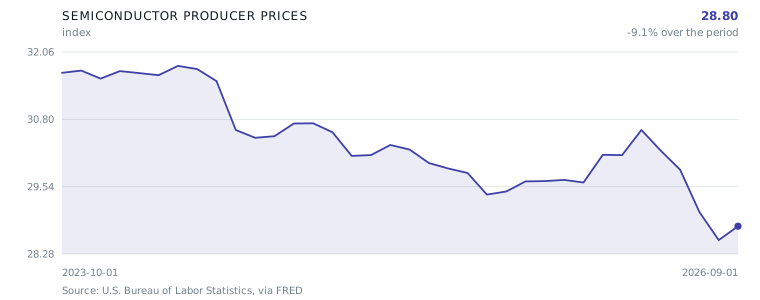
The available indicators are narrow. Information-sector employment was recorded at 2,739 on 1 September 2026. The electricity price indicator was recorded at 0.196 on the same date, but the unit is not stated. Semiconductor PPI rose from 28.472 on 1 August 2026 to 28.801 on 1 September 2026, an increase of 0.329 points.
Those figures do not settle the argument. The employment number is a snapshot, not a trend. The electricity indicator cannot be compared without knowing its unit. The semiconductor figure is a level near 28, and no explanation is given for its base. The hard part is not getting capital to arrive; it is making that capital pay for local skills, suppliers and budgets.
The policy direction is visible. The evidence is still too thin to call the outcome. Watch whether Bac Ninh publishes a baseline for its 700-firm target, and whether budget language turns into revenue measures that survive a slow quarter.
- 01Provincial authorities say Bac Ninh has $49 billion in foreign direct investment capital.
- 02Bac Ninh aims for 700 supporting-industry enterprises by 2030.
- 03The IMF said Malaysia should broaden its tax base and improve subsidy targeting.
- 04Semiconductor PPI rose from 28.472 to 28.801 between 1 August and 1 September 2026.
- 05Information-sector employment was recorded at 2,739 on 1 September 2026.
Interpretation, not reporting. The facts above carry their tiers; this is one correspondent’s reading of them.
The credible story here is not momentum; it is conditionality. Bac Ninh’s authorities can point to $49 billion in foreign direct investment capital and double-digit growth, but their target of 700 supporting-industry enterprises by 2030 shifts the test from attraction to absorption. I would watch whether budget conclusions and tax-base advice turn into revenue measures that fund local suppliers and withstand shocks. The semiconductor producer-price index rising from 28.472 to 28.801 is modest, yet it matters because it shows price pressure in a strategic input. What would change my mind? Clear disclosures: whether $49 billion is stock or flow, what double-digit growth means, and the current count of supporting firms. Until then, I treat the upbeat framing as a direction of travel, not a proven model.
— Magnus Ebbesen
Every claim in this article, and what it rests on
We do not ask you to take our word for it. Each statement below carries its tier and its sources. Where sources disagree, you get both accounts and what would settle it.
Information-sector employment was recorded at 2,739 on 2026-09-01.
The electricity price indicator was recorded at 0.196 on 2026-09-01.
Semiconductor PPI rose from 28.472 on 2026-08-01 to 28.801 on 2026-09-01.
Bac Ninh recorded double-digit economic growth.
Bac Ninh has $49 billion in foreign direct investment capital.
Bac Ninh aims to have 700 supporting-industry enterprises by 2030.
The IMF said Malaysia should broaden its tax base and improve subsidy targeting to withstand future shocks.
The Party Executive Committee issued a conclusion covering 2026 state budget implementation and 2027 planning.
The case against this story
Written by an adversarial reviewer, not the correspondent
The story assembles a patchwork of upbeat indicators—Bac Ninh's double-digit growth, $49 billion in FDI, a target of 700 supporting-industry firms by 2030—alongside an IMF recommendation for Malaysia and three highly specific data points (information-sector employment at 2,739, an electricity price indicator at 0.196, semiconductor PPI rising from 28.472 to 28.801). None of these claims are contextualised: we do not know whether the employment figure covers a province or a nation, what unit the electricity indicator uses, or why the semiconductor PPI sits near 28 rather than the standard base of 100. The Bac Ninh claims read like a government press release—uniformly positive, forward-looking, and free of any risks, bottlenecks, or downside scenarios. A reader cannot assess whether $49 billion in FDI is cumulative or annual, whether 'double-digit growth' means 10 percent or 19 percent, or whether the 700-enterprise target is realistic against current counts. The story's overall picture is one of unbroken Asian economic momentum, but it is built on decontextualised numbers and promotional framing rather than balanced analysis.
Who benefits from this framing: Bac Ninh's provincial authorities and Vietnam's economic planners benefit from positive growth and FDI framing that could attract further investment and validate industrial policy. Foreign manufacturers operating in Bac Ninh benefit from a rosy investment-climate narrative. The IMF gains amplification of its fiscal-policy recommendations for Malaysia. Semiconductor and electronics industry interests benefit from a rising PPI trend that signals pricing power. If readers accept this framing without questioning the missing context, they may make investment or policy decisions based on incomplete and possibly promotional information.
Report an error in this article
Subscriptions open at launch
Future Systems Review will be a paid publication. Reading is free while we build the archive — leave an address and we will write to you once, when subscriptions open.