
ASML and India widen the chip story on thin data
A raised ASML forecast and an India roadmap suggest a broader build-out, but the available numbers are bare.
 Rafael ImaiCompute, chips and power
The story pairs a raised ASML forecast with a Strat360PL report on India’s electronics and semiconductor path. The accompanying figures are information-sector employment, an electricity price and a semiconductor PPI. As stated, they do not establish scale, geography or capacity.
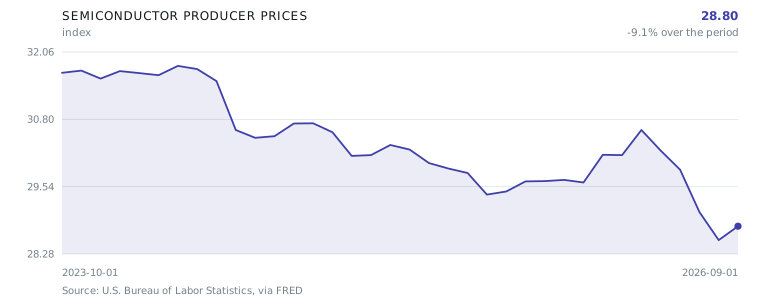
2,739, 0.196 and 28.472 are the numbers attached to a much larger story about chips. The first is information-sector employment in September 2026. The second is an electricity price on 1 September. The third is a semiconductor producer-price index reading in August.
The wider argument is that ASML’s raised outlook and India’s semiconductor roadmap point to a broader, more diversified build-out. The available material is thinner than that conclusion.
A forecast without a line item
The account of ASML says only that the company’s forecast was raised. It does not say whether the change applies to revenue, earnings, shipments, bookings or another measure. It also does not give a period, a prior forecast or a new figure.
That matters because equipment makers sit early in the chain. A raised forecast can mean more tools, higher prices, better margins or simply a revised assumption. Without the line item, the direction is visible but the magnitude is not.
For investors, the difference is material. A change in shipment expectations affects capacity years out. A change in margin guidance affects the company’s own economics. The same phrase, “forecast was raised,” does not distinguish between them. The reader is left with a direction and no dial.
The report’s movement through outlets is evidence of attention, not of capacity.
A roadmap with a wire trail
The India piece is easier to trace. A Strat360PL report charts India’s path to a deeper electronics and semiconductor industry. It was published by ANI News India. The same report was then carried by Malaysia Sun, Calcutta News and Sydney Sun.
That sequence shows distribution, not independent confirmation. A wire story can land on many sites without each one examining the underlying assumptions. The appearance of the same material in several outlets tells the reader about reach. It does not, by itself, tell the reader whether the roadmap is funded, permitted or likely to become factories.
The physical test is harder than publication. A semiconductor build-out needs power, water, materials, logistics and trained operators. It also needs contracts and construction schedules. The report’s movement through outlets is evidence of attention, not of capacity.
The report’s title suggests ambition, but ambition is not a fab. The gap between a roadmap and a working plant is filled by permits, power agreements, water rights, supplier contracts and hiring plans. None of those appears here.
Three numbers without a ruler
The macro readings are equally spare. Information-sector employment was 2,739 in September 2026. The electricity price was 0.196 on 1 September. The semiconductor PPI was 28.472 in August.
Each figure could be meaningful with a unit, a market, a base year or a prior reading. As stated, none carries that context. The electricity price cannot be compared with a tariff or a wholesale hub because neither is named. The employment figure cannot be scaled because no unit is attached. The semiconductor PPI cannot be read as inflation, deflation or a sector turn without knowing its base and basket.
The three readings also do not move together in any visible way. Employment, power cost and chip prices sit in different markets and respond to different forces. Without series definitions, they cannot be combined into a dashboard.
The most direct of the three is the semiconductor PPI, because it at least points to the product category. But a single index level is not a trend. It is a coordinate without a map.
The open question is whether the next set of disclosures supplies the missing rulers: the ASML line item, the India funding and permits, and the units that turn three isolated numbers into a measurable build-out.
- 01Information-sector employment was 2,739 in September 2026.
- 02The electricity price was 0.196 on 1 September 2026.
- 03The semiconductor PPI was 28.472 in August 2026.
- 04ASML’s forecast was raised.
- 05A Strat360PL report was published by ANI News India and carried by Malaysia Sun, Calcutta News and Sydney Sun.
Interpretation, not reporting. The facts above carry their tiers; this is one correspondent’s reading of them.
The interesting part of this story is not the direction; it is the plumbing. ASML’s forecast is said to have been raised, but the statement does not name the measure, the period or the size. The India roadmap has a clear distribution path — Strat360PL, ANI News India, then Malaysia Sun, Calcutta News and Sydney Sun — yet that path shows syndication more than independent verification. The three numbers, 2,739, 0.196 and 28.472, are precise but lack the units and baselines that would let me place them. I would treat this as a narrative about attention rather than capacity. If later disclosures attach the ASML raise to a named line item and if the India material acquires more detail, the picture could change. Until then, the fragments do not measure a build-out.
— Rafael Imai
Every claim in this article, and what it rests on
We do not ask you to take our word for it. Each statement below carries its tier and its sources. Where sources disagree, you get both accounts and what would settle it.
Information sector employment was 2,739 in September 2026.
The electricity price was 0.196 on 2026-09-01.
The semiconductor PPI was 28.472 in August 2026.
ASML’s forecast was raised.
A Strat360PL report charts India’s path to a deeper electronics and semiconductor industry.
The Strat360PL report was published by ANI News India.
The same Strat360PL report was carried by Malaysia Sun, Calcutta News, and Sydney Sun.
The case against this story
Written by an adversarial reviewer, not the correspondent
The story combines three context-free economic data points — an employment figure stated without units, an electricity price without currency or market, and a PPI value without series identification — with a Strat360PL report on India's semiconductor industry that was distributed via ANI News India and then appeared on Malaysia Sun, Calcutta News, and Sydney Sun. The economic numbers are impossible to evaluate independently because they strip away the context that makes them meaningful. The India semiconductor report's appearance on multiple outlets likely reflects automated content syndication through ANI's distribution network rather than independent editorial coverage by each outlet — the same wire story landing on multiple sites is not the same as multiple outlets independently reporting the same finding. The ASML forecast claim is vague about which forecast was raised (revenue? earnings? shipments?) and over what period. Together, these elements create the impression of a data-rich, well-sourced narrative about semiconductor industry growth when the actual evidence is either contextually incomplete, potentially republished promotional content, or too vaguely stated to verify.
Who benefits from this framing: Readers who accept this framing benefit Strat360PL and similar firms that gain visibility for their industry reports; ANI News India and its syndication partners, which gain content and traffic from republishing the same story across multiple sites; promoters of investment in India's electronics and semiconductor sector, including industry associations and government economic development bodies that can cite the report as evidence of momentum; and ASML, whose raised-forecast claim reinforces a positive industry-growth narrative that supports investor sentiment in semiconductor equipment stocks.
Report an error in this article
Subscriptions open at launch
Future Systems Review will be a paid publication. Reading is free while we build the archive — leave an address and we will write to you once, when subscriptions open.