
ASML’s China surge meets a broader AI labour warning
Equipment flows, export controls and AI labour risk are converging into one policy problem.
 Rafael ImaiCompute, chips and power
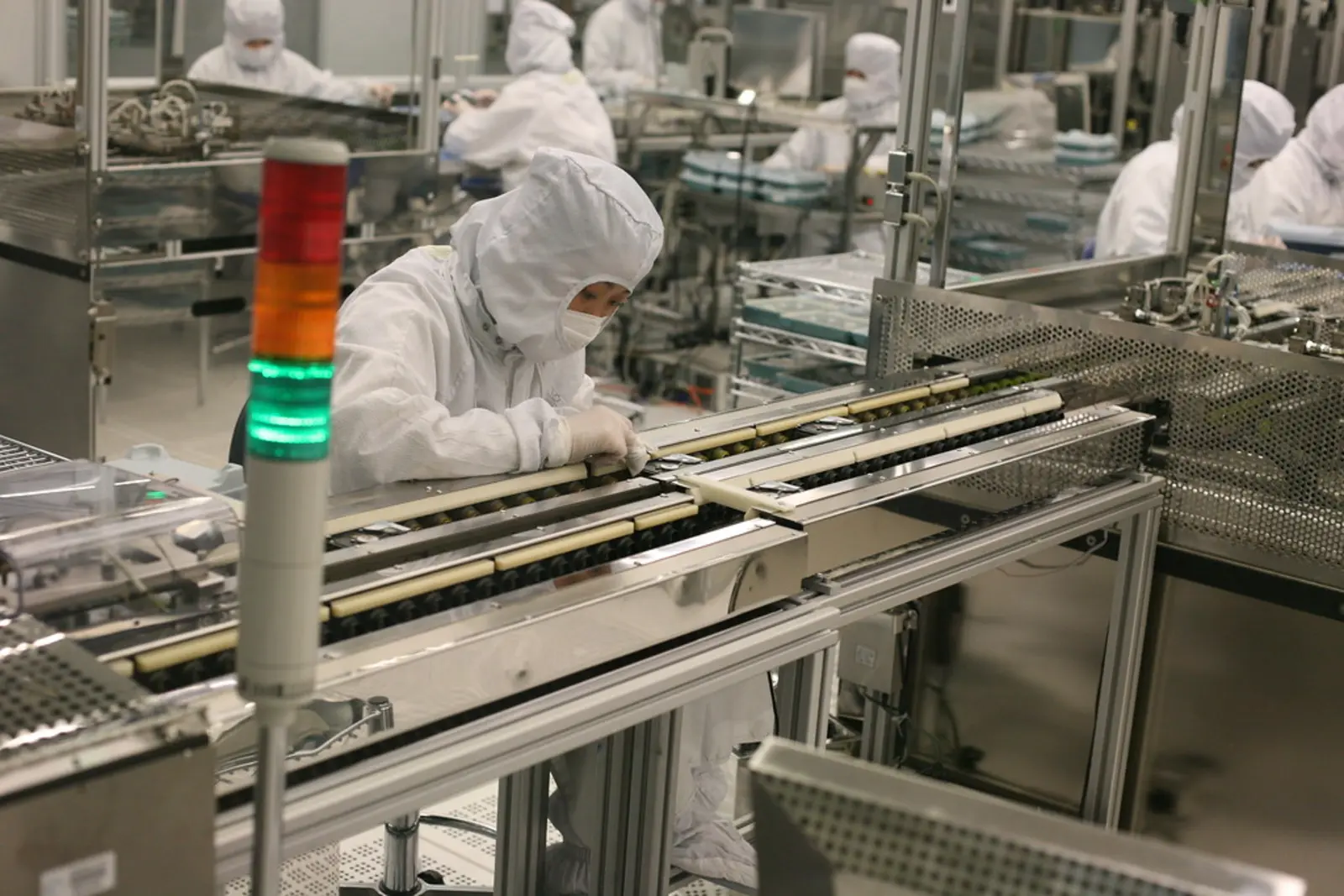
ASML says chip-equipment sales to China rose 109%, even as the US pushes export curbs. The company expects China to account for about 20% of total sales this year. Former US commerce chief Raimondo’s warning that AI could repeat a job-costing China shock adds a labour-market dimension to the supply-chain story.
A big percentage, a smaller share
ASML says its chip-equipment sales to China rose 109%, even as the US pushes to curb such exports. The company expects China to account for about 20% of total sales this year. That combination points to a market that is still large, still buying and still moving through the export-control perimeter.
A 109% increase is a ratio, not a volume. It tells us the change relative to the earlier level, not the absolute number of tools shipped. And a 20% expected share means four-fifths of ASML’s sales still sit outside China, even if China remains a large single market.
The rise is not a clean signal of underlying demand. A percentage gain can be magnified by a small prior base, and buyers can pull orders forward when they expect restrictions to tighten. The 20% share may also look smaller than an earlier peak if China previously accounted for more. The number, in other words, is loud but not self-explanatory.

This is why the phrase “despite” needs caution. A rise during an export-curbing push may show demand, but it may also show timing. If customers expect fewer sales later, current deliveries can rise before the gate closes. The same invoice can look like strength in one quarter and pull-forward in the next.
A surge can therefore mean confidence in demand, fear of cutoff, or both at once.
Raimondo moves the risk from tools to jobs
Former US commerce chief Raimondo warned that rapid and unbridled AI development has the potential to disrupt the US economy in a way comparable to the China shock that cost jobs. That is not a comment on ASML’s order book. It turns the lens from supply chains to labour markets and policy response.
Her warning is about domestic economic risk: what happens when a technology spreads faster than workers, firms or institutions can adjust. It does not require a judgment on whether export controls are working. It asks a different question: whether the US can absorb AI’s economic effects without repeating the job losses associated with the earlier China shock.
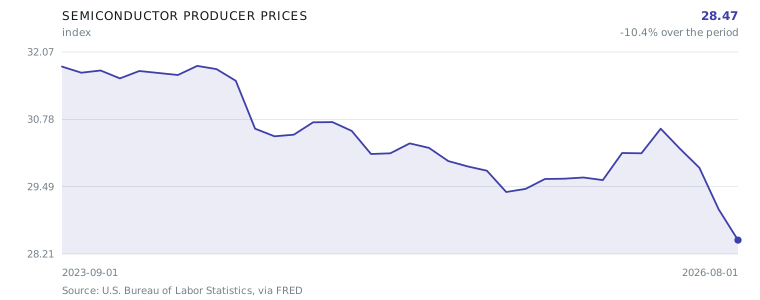
The accompanying data include two instrument readings: INFO_SECTOR_EMP at 2,739 on 1 September 2026 and SEMI_PPI at 28.472 on 1 August 2026. Without units, history or direction, those figures cannot say whether conditions are tightening or loosening. They are markers, not evidence of a trend.
The names suggest labour and prices, but the values carry no context. A single point can be noise, especially in a fast-moving chip cycle. If the series are indexes, the reader needs a base period; if they are prices or employment measures, they need units and a comparison. As presented, they add precision without a baseline.
The bottleneck is policy, not just lithography
The physical chain is straightforward. ASML sells equipment used to make chips; when buyers in China purchase more tools, they are buying capacity for future output. But the commercial flow is now filtered through export rules and customer expectations of future constraints. A surge can therefore mean confidence in demand, fear of cutoff, or both at once.
Raimondo’s warning broadens the frame again. If AI can repeat a China-style job shock, the policy question is not only who sells advanced tools, but who bears the cost when production shifts. That links chip strategy to employment and political tolerance for disruption.
For investors and policymakers, the useful conclusion is narrower than the headline. The ASML figures show China remains a significant buyer. Raimondo’s remarks show anxiety about AI’s domestic economic effects. The two belong to the same China-shock story only if trade controls, industrial capacity and labour markets are read together. The open question is whether policy can move fast enough to affect any of those before the next capacity wave arrives.
- 01ASML’s chip-equipment sales to China rose 109%.
- 02The rise occurred despite a US export-curbing push.
- 03ASML expects China to account for about 20% of total sales this year.
- 04Raimondo warned AI risks could repeat a China shock that cost jobs.
- 05INFO_SECTOR_EMP was 2,739 on 1 September 2026; SEMI_PPI was 28.472 on 1 August 2026.
Interpretation, not reporting. The facts above carry their tiers; this is one correspondent’s reading of them.
The useful lesson is that export controls and labour-market risk are no longer separate conversations. I see the ASML numbers as a timing signal as much as a demand signal: a 109% rise can be powerful, but it can also be pulled forward by fear of future curbs. The expected 20% China share tells me the market remains important without being dominant. Raimondo’s warning shifts the focus from who sells tools to who absorbs disruption when technology moves faster than the workforce. The two instrument readings do not settle anything because they lack units and trend. If the next data show the sales share falling while employment or price measures move sharply, I would read that as policy starting to bite. If China remains near 20% and the labour indicators stay stable, I would treat the shock talk as premature. The real test is whether the physical flow of tools and the political response to AI-driven displacement begin to move together.
— Rafael Imai
Every claim in this article, and what it rests on
We do not ask you to take our word for it. Each statement below carries its tier and its sources. Where sources disagree, you get both accounts and what would settle it.
The INFO_SECTOR_EMP instrument recorded a value of 2,739 for 2026-09-01.
The SEMI_PPI instrument recorded a value of 28.472 for 2026-08-01.
ASML’s chip equipment sales to China rose 109%.
The 109% rise in ASML’s China chip-equipment sales occurred despite a US export-curbing push.
ASML expects China to account for about 20% of its total sales this year.
Former US commerce chief Raimondo warned that AI risks could repeat a China shock that cost jobs.
Raimondo said rapid and unbridled AI development has the potential to disrupt the US economy in a way comparable to the China shock.
The case against this story
Written by an adversarial reviewer, not the correspondent
The story stitches together three separate narratives—ASML's China sales surge, Raimondo's AI warning, and two instrument readings—into a picture of failed export controls and looming economic disruption, but the causal logic is thin. The 109% rise in ASML's China chip-equipment sales could reflect a very low base or front-loading before tighter controls take effect, not sustained growth in defiance of restrictions. The expectation that China accounts for about 20% of ASML's total sales might actually represent a decline from prior levels if China previously made up a larger share. Raimondo's warning about AI disruption concerns domestic economic risk, not export control effectiveness—linking it to the ASML sales story is editorial inference. The instrument readings (INFO_SECTOR_EMP at 2,739 and SEMI_PPI at 28.472) are presented without units, historical context, or trend direction, making them impossible to interpret as evidence of anything. Without knowing whether these values are high, low, or typical, they add false precision rather than insight.
Who benefits from this framing: Readers who accept this framing conclude that US export controls on chip equipment to China are failing and that AI poses a China-shock-level economic threat. This benefits critics of current US China policy who can argue controls are ineffective; hawks who want even stricter export measures; Chinese state interests demonstrating technological resilience despite Western restrictions; ASML investors reassured of strong demand; and advocates for slowing AI development domestically by equating it with the job losses attributed to the China shock.
Report an error in this article
Subscriptions open at launch
Future Systems Review will be a paid publication. Reading is free while we build the archive — leave an address and we will write to you once, when subscriptions open.