
Autonomous agents get sovereignty talk while robots stay human-led
The language around AI is shifting from productivity to control, and that shift can change procurement before capability does.
 Ines KovačFrontier models and AI agents
El Heraldo’s “Tecnopatria” column and a bare information-sector employment reading show AI being pulled into sovereignty and inequality debates. Capability descriptions still lean on long-horizon autonomy and robot self-improvement, but they omit success rates, supervision and context. The political frame may matter sooner than the deployment numbers.
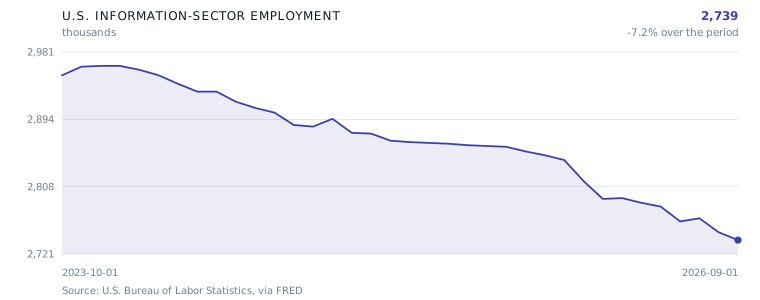
On 10 October, El Heraldo published an opinion column titled “Tecnopatria,” five weeks after an information-sector employment reading reached 2,739 on 1 September. Neither item, by itself, describes a model, a robot or a contract. Together they mark a change in the language around autonomous systems: productivity is no longer the only frame. Sovereignty, danger and inequality are entering the same discussion.
That matters because political language changes what buyers ask for. If agents are treated as productivity tools, procurement focuses on cost per task, latency and integration. If they are treated as instruments of national control or symbols of concentrated wealth, the questions move to ownership, location, shutdown rights and who captures the surplus. Those are budget and regulation questions, not demo questions.
Autonomy descriptions need a success rate
The capability side is built around long-horizon agents. One description says these agents can work autonomously for hours to days on economically valuable tasks. The phrase is doing a lot of work. It does not say how often the tasks succeed, how much supervision is required, what counts as economically valuable, or whether the work survives contact with messy systems, permissions and exceptions.
Long-horizon work is hard because the failure mode is not a wrong answer; it is drift. A system can start with a plausible plan, make a small error, then spend hours compounding it unless it can detect the mistake, recover state and ask for help at the right moment. The gap between a controlled demonstration and an ordinary Tuesday is measured in hand-offs, retries and audit logs. Those numbers are absent.
Autonomy in execution is not the same as autonomy in improvement.
The robotics descriptions carry a similar tension. One description says robots are increasingly autonomous in task execution. Another caveat says their improvement remains largely human-driven. Both can be true. A robot can execute more steps without a person in the loop while its training data, maintenance, teleoperation, hardware fixes and redesign still come from people. Autonomy in execution is not the same as autonomy in improvement.
Self-improvement is a research word, not a deployment word
The strongest language sits in one research description: research investigates physical recursive self-improvement for robots. Optimists read that as a serious direction, because recursive improvement is the idea of a system becoming better at making itself better. Skeptics counter that “investigates” can describe a theoretical paper, a simulation or a narrow experiment, not a machine that upgrades itself in production.
That distinction matters. Physical recursive self-improvement would require changes in hardware, control, safety or manufacturing that a system can initiate and validate. The description does not establish that such a loop exists outside human direction. It establishes that the question is being asked. For buyers, that is a research signal, not a delivery date.
The employment figure has the same problem of missing context. A reading of 2,739 is precise, but precision is not significance. Without knowing what the series measures, its baseline, its volatility or its direction, the number cannot show whether AI is creating work, displacing it or creating a new category that old statistics miss.
Danger and wealth are now part of the same frame
The non-US coverage adds a political layer. A Jerusalem Post item on Arab press voices is described as including AI dangers among its topics. That places AI alongside security, culture and regional anxiety rather than beside software subscriptions. Separately, commentary is comparing Musk's wealth in size to the world's 23rd-largest economy. Whether or not the comparison is exact, it turns a fortune into a macroeconomic object.
These two threads meet in the sovereignty story. A state that worries about dangerous agents and a public that worries about extreme concentration will not respond to the same incentives as a company buying efficiency. The first wants control and accountability. The second wants to know who pays and who gains. “Tecnopatria” is a small marker, but it points to the same place: technology being absorbed into the language of nation and belonging.
The open question is whether procurement and regulation follow this rhetoric. If they do, the winners will not be the agents that look most autonomous in a video. They will be the systems whose owners can explain supervision, failure, cost and control.
- 01El Heraldo published an opinion column titled “Tecnopatria” on 10 October.
- 02The information-sector employment reading was 2,739 on 1 September.
- 03Research is described as investigating physical recursive self-improvement for robots, with its practical status disputed.
- 04Long-horizon agents are described as able to work autonomously for hours to days on economically valuable tasks.
- 05A Jerusalem Post item is described as including AI dangers, while Musk's wealth is compared to the world's 23rd-largest economy.
Interpretation, not reporting. The facts above carry their tiers; this is one correspondent’s reading of them.
The sovereignty frame is doing more work than the autonomy evidence. I can see why it travels: national purpose and inequality are easier to argue about than success rates. But the descriptions do not settle deployment. Long-horizon agents are said to work for hours or days, yet no failure rate appears. Robots are said to be more autonomous, yet improvement is described as human-driven. Research into physical recursive self-improvement may be serious, but “investigates” is not a machine. I would watch whether procurement starts demanding audit trails, local control and failure accounting. If it does, the political story becomes industrial. If it does not, this remains rhetoric around thin numbers and thin context that cannot be audited yet by anyone.
— Ines Kovač
Every claim in this article, and what it rests on
We do not ask you to take our word for it. Each statement below carries its tier and its sources. Where sources disagree, you get both accounts and what would settle it.
El Heraldo published an opinion column titled “Tecnopatria” on 2026-10-10.
The information-sector employment reading was 2,739 on 2026-09-01.
Research investigates physical recursive self-improvement for robots.
Long-horizon agents can work autonomously for hours to days on economically valuable tasks.
Robots are increasingly autonomous in task execution.
Robots’ improvement remains largely human-driven.
A Jerusalem Post item on Arab press voices includes AI dangers among its topics.
Musk’s wealth is being compared in size to the world’s 23rd-largest economy.
The case against this story
Written by an adversarial reviewer, not the correspondent
The story builds a narrative of accelerating AI and robotics advancement by stacking vague capability claims on top of specific-sounding but context-thin data points. The claim that long-horizon agents 'can work autonomously for hours to days on economically valuable tasks' is broad and silent on success rates, supervision levels, or what counts as 'economically valuable.' The claim that robots are 'increasingly autonomous' sits in direct tension with the admission that their 'improvement remains largely human-driven' — the story wants credit for progress toward autonomy while hedging that nothing fundamental has changed. The leap to 'research investigates physical recursive self-improvement' implies a trajectory toward self-improving machines, but the vague verb could cover a single theoretical paper, not actual progress. Meanwhile, precise-sounding items like an employment reading of 2,739 or a column titled 'Tecnopatria' may be factually correct yet are presented without context that would let a reader gauge their significance. The cumulative effect is to make incremental, uncertain, and partly contradictory developments sound like a coherent march toward autonomous, self-improving robotics — a framing that outpaces what the individual claims, examined on their own terms, actually establish.
Who benefits from this framing: AI and robotics companies and their investors benefit from framing the technology as more advanced and autonomous than the evidence strictly supports, attracting capital, talent, and customer interest. Media outlets benefit from a narrative of rapid, potentially alarming progress, which drives engagement. Advocacy groups on both sides of AI regulation benefit — those seeking urgent restrictions can cite 'recursive self-improvement' research as evidence of imminent risk, while those seeking deregulation or investment can cite 'economically valuable autonomous work' as proof of competitive advantage. Musk benefits from the comparison of his wealth to a national economy, which reinforces his outsized influence and status. The framing ultimately serves anyone with a financial or political stake in making AI progress seem either more imminent or more dangerous than the underlying claims, individually examined, actually demonstrate.
Report an error in this article
Subscriptions open at launch
Future Systems Review will be a paid publication. Reading is free while we build the archive — leave an address and we will write to you once, when subscriptions open.