
Battery futures meet a flat power-price signal
Two identical electricity-price readings make the grid-intelligence trade harder to trust.
 Rafael ImaiCompute, chips and power
MIT Technology Review's The Download carried the title 'faking blood and the future of batteries' on 14 October, but the quieter test is data quality. Electricity prices were reported at 0.196 on both 1 August and 1 September, while an employment figure lacks a unit. An arXiv record says separate per-grid models cap day-ahead price-forecasting accuracy, a strong wording that needs its primary document.
On 14 October, MIT Technology Review's The Download carried the title 'faking blood and the future of batteries'. The title points to batteries, but the harder signal is the market data that would tell anyone when a battery is useful.
The grid-intelligence idea rests on data. It needs prices that move, models that can learn from those moves and series clean enough to back a decision. The available numbers are not yet doing that work.
The available series are simple: electricity price, semiconductor producer prices and information-sector employment. Each could matter to a grid-intelligence trade, but each arrives with a caveat.
A flat price is a hard place to start
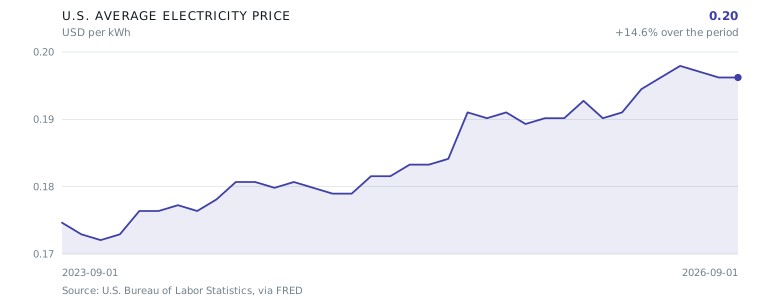
The electricity-price series shows 0.196 on 1 August and 0.196 on 1 September. Two identical readings can mean calm prices, or they can mean the meter is not really being read. For a forecasting system, the difference matters: a model trained on a flat line has little to distinguish a real market from a stuck feed.
A flat series also compresses the job of a forecast. If the next price is assumed to be 0.196, the error may look small even when the model is not capturing the market. Accuracy can then become a surface metric rather than evidence that the signal is real.
Two identical readings can mean calm prices, or they can mean the meter is not really being read.
The problem is not that 0.196 is high or low. It is that the same three-decimal value appears in two consecutive months. If that is genuine stability, it is a strong fact. If it is a retrieval artifact, it quietly undermines any analysis built on the series.
Models run into the grid's seams
An arXiv record states that fitting separate models per grid caps day-ahead electricity-price forecasting accuracy. The record also describes the usual setup: day-ahead forecasting is posed per market, and a separate model is fitted to each grid's own history.
That framing points to a structural tension. Power markets are local enough that each grid has its own behaviour, but the modelling choice that follows may limit what forecasting can achieve. One reading is that the cap is real. Another is that the verb is stronger than a single record can carry, and the finding needs the primary document, methods and sample before it becomes a rule.
Separate models have an obvious appeal: they can follow each grid's own history. The record's wording suggests that this appeal may come with a ceiling. If each grid is treated as its own problem, a model may not borrow strength from similar conditions elsewhere. That would make the limit a design constraint, not just a tuning issue.
The surrounding numbers are thin
The other series do not fill the gap. Information-sector employment was 2,739 on 1 September, but the figure is presented without a unit. That makes it impossible to say whether it counts thousands of jobs, an index level, or something else.
For anyone building a data-driven case, the missing unit is not a small formatting problem. It changes the scale. A figure of 2,739 could be a level, a change, or a count in an unspecified population, and each would lead to a different conclusion.
The semiconductor producer price index was 28.472 on 1 August. The number is a producer-price index, but one level without a base or a prior comparison is not a trend. It sits beside the electricity price as a data point that needs context before it can support a trade.
The open question is not whether batteries will matter. It is whether the price and employment feeds are reliable enough to turn grid data into an investment signal.
- 01MIT Technology Review's The Download was titled 'faking blood and the future of batteries' on 14 October.
- 02The electricity price was 0.196 on 1 August and 0.196 on 1 September.
- 03An arXiv record says separate per-grid models cap day-ahead electricity-price forecasting accuracy.
- 04Information-sector employment was reported as 2,739 on 1 September, with no unit attached.
- 05The semiconductor producer price index was 28.472 on 1 August.
Interpretation, not reporting. The facts above carry their tiers; this is one correspondent’s reading of them.
The grid-intelligence trade is only as good as its inputs. I see two identical electricity-price readings, 0.196 on 1 August and 1 September, and I do not know whether to read them as calm or as a bad feed. That uncertainty matters more than the headline about batteries, because forecasting models need clean history. The arXiv record's statement that separate per-grid models cap accuracy is strong, and I would hold it lightly until the primary document, methods and sample are checked. The missing unit on the information-sector employment figure is another warning sign. If the data is real and stable, flat prices reduce the value of short-term forecasting; if it is an artifact, any analysis built on it is fragile. I would watch for revised series, units and more price readings before treating this as a durable investment layer. A second month of 0.196 would not settle it; a revised series might.
— Rafael Imai
Every claim in this article, and what it rests on
We do not ask you to take our word for it. Each statement below carries its tier and its sources. Where sources disagree, you get both accounts and what would settle it.
MIT Technology Review's The Download was titled 'faking blood and the future of batteries' on 2026-10-14.
Information-sector employment was 2,739 on 2026-09-01.
The electricity price was 0.196 on 2026-09-01.
The electricity price was 0.196 on 2026-08-01.
The semiconductor producer price index was 28.472 on 2026-08-01.
The arXiv record states that fitting separate models per grid caps day-ahead electricity price forecasting accuracy.
Day-ahead electricity price forecasting is usually posed per market.
In the usual day-ahead electricity price forecasting setup, a separate model is fitted to each grid's own history.
The case against this story
Written by an adversarial reviewer, not the correspondent
The story's picture rests on two pillars: that per-grid electricity price forecasting models 'cap' accuracy, and a set of specific economic data points. Both are weakened by quality issues. The claim that separate models 'cap' accuracy uses stronger causal language than an arXiv paper would typically employ—papers more often say 'may limit' or 'could affect.' The identical electricity prices (0.196) reported for two different months (August and September 2026) suggest a data retrieval error rather than genuine price stability to three decimal places. The employment figure of 2,739 is presented without units, making it impossible to verify or interpret. Together, these issues suggest the story may be built on overstatement of research findings and unreliable data sourcing, undermining confidence in the overall narrative.
Who benefits from this framing: Researchers and companies promoting cross-grid or multi-market electricity price forecasting approaches benefit from the framing that per-grid models 'cap' accuracy—the stronger the language, the more compelling the case for their alternative methods. The arXiv paper's authors benefit from their work being cited as demonstrating a fundamental limitation of current practice. Commercial vendors of multi-market forecasting solutions benefit from a narrative that positions their approach as necessary to overcome an accuracy ceiling.
Report an error in this article
Subscriptions open at launch
Future Systems Review will be a paid publication. Reading is free while we build the archive — leave an address and we will write to you once, when subscriptions open.