
Cheap AI models and smart-device warnings are not one market risk yet
Security warnings and bare indicators point to different exposures, and the gap matters for liability.
 Ines KovačFrontier models and AI agents
A 19 October 2026 report flagged security concerns over cheap Chinese AI models, while Turkish-language coverage warned about AI worms and unplugged household devices. The economic indicators listed with the story are too bare to show a shared market risk. The real question is whether warnings become product-safety action.
The market-risk version of consumer AI security has arrived ahead of its evidence. On 19 October 2026, a report flagged security concerns over cheap Chinese AI models. In Turkish-language coverage, warnings circulated that AI worms may put refrigerators at risk, and that household devices from robot vacuums to televisions can remain dangerous even when unplugged.
Those are not the same kind of problem. One is a supply-chain concern about low-cost models. Another is a consumer-internet warning about appliances. A third is a set of economic numbers that, as published, cannot be turned into a cost story without units or source context.
The warnings are real, but the chain is thin
The refrigerator warning is conditional: reports said AI worms may put refrigerators at risk, not that a worm had spread through appliance fleets. That distinction matters because a connected refrigerator is not only a cold box; it is a networked endpoint, often patched slowly and left running for years. If malicious code could move from one weakly secured device to another, the route would matter more than the appliance brand.
The second Turkish-language point is broader and harder to price. It said household devices from robot vacuums to televisions can remain dangerous even when unplugged. Taken literally, that points to residual risk in batteries, capacitors, firmware or mechanical parts. But the coverage did not supply a common dataset, a named incident class, or a regulator's finding. It described a category of unease rather than a measurable failure rate.
The market-risk version of consumer AI security has arrived ahead of its evidence.
Cheap AI models raise a different question. A low-cost model can reach millions of devices because it is small enough and cheap enough to run on modest hardware. If the model or its update channel is insecure, the exposure is not one bad app; it is a fleet of products that share the same weakness. The 19 October report flagged that concern, but it did not, by itself, establish how often the flaw is exploited or who would pay when it is.
The indicators do not yet speak to one market
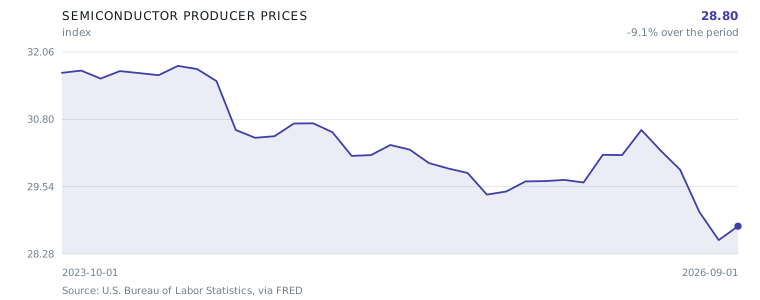
The economic indicators listed with this subject are precise but bare. The information-sector employment indicator was 2,739 for 1 September 2026. The electricity price indicator was 0.196 for 1 September 2026. The semiconductor PPI indicator was 28.801 for 1 September 2026.
Those figures may be useful inside a defined series, but outside that context they do not tell an investor or a product team whether costs are rising, employment is tightening, or chip prices are stabilising. Is 2,739 measured in thousands of jobs, or in an index? Is 0.196 dollars per kilowatt-hour, euros, or a normalised ratio? Is 28.801 an index level or a percentage change? Without those answers, the numbers are decoration rather than evidence.
That matters because market risk needs a transmission path. A security flaw becomes a financial problem when it changes shipments, warranty costs, recalls, insurance premiums, regulatory fines or brand trust. The available items do not yet show that path. They show warnings, a report and three unexplained indicators.
Liability may arrive before standards
The plausible route is not a sudden AI-worm apocalypse. It is slower: a device maker ships a low-cost product with a model runtime, an update mechanism or a network stack that is later found insecure. A regulator asks for remediation. Retailers demand certification. Insurers price the category differently. Consumers who bought the product discover that the thing in their kitchen or living room cannot be fixed quickly.
In that sequence, the cheap model is the cost lever, the connected appliance is the attack surface, and the economic indicators are background noise unless they are tied to units and time series. The open question is whether any authority will treat these warnings as a product-safety matter before a large incident forces the issue.
- 01A report dated 19 October 2026 flagged security concerns over cheap Chinese AI models.
- 02Turkish-language reports warned AI worms may put refrigerators at risk.
- 03Turkish-language coverage said household devices can remain dangerous even when unplugged.
- 04The 1 September 2026 indicators were 2,739 for information-sector employment, 0.196 for electricity price and 28.801 for semiconductor PPI.
Interpretation, not reporting. The facts above carry their tiers; this is one correspondent’s reading of them.
The weakest part of this story is not the refrigerator; it is the jump from warning to market risk. I see three separate exposures: insecure low-cost model supply chains, poorly patched consumer devices, and economic indicators that lack units. Only the first two have a plausible liability path, and even they are conditional. If regulators turn warnings into formal remediation, the risk becomes concrete. If not, the warnings may remain a reputational issue for vendors rather than a cost shock for the supply chain. I would watch semiconductor PPI only if it can be tied to a defined series; today, 28.801 does not tell me whether hardware is getting cheaper or dearer. The thing that would change my view is a documented incident with a named product class, a recall or an insurer's pricing change. Until then, this looks like an emerging governance problem, not a proven loss event.
— Ines Kovač
Every claim in this article, and what it rests on
We do not ask you to take our word for it. Each statement below carries its tier and its sources. Where sources disagree, you get both accounts and what would settle it.
The information-sector employment indicator was 2,739 for 1 September 2026.
The electricity price indicator was 0.196 for 1 September 2026.
The semiconductor PPI indicator was 28.801 for 1 September 2026.
Turkish-language reports warned that AI worms may put refrigerators at risk.
A report dated 19 October 2026 flagged security concerns over cheap Chinese AI models.
Turkish-language coverage said household devices from robot vacuums to televisions can remain dangerous even when unplugged.
The case against this story
Written by an adversarial reviewer, not the correspondent
The story bundles together unrelated items with no shared sourcing: a report about security concerns over cheap Chinese AI models, Turkish-language warnings about AI worms threatening refrigerators, Turkish-language claims about household devices remaining dangerous even when unplugged, and three bare economic indicators covering employment, electricity prices, and semiconductor PPI. None of these claims reference a common source, dataset, or investigation. The AI-worms-in-refrigerators claim is speculative ('may put at risk') and sourced only to unnamed 'Turkish-language reports,' making it the weakest link. The three economic indicators are presented as raw numbers with no methodology, unit definition, or source publication, so a reader cannot assess whether 2,739 is in thousands or persons, whether 0.196 is in dollars or euros per kWh, or whether 28.801 is an index value or a percentage change. The overall picture implies a coherent narrative about technology threats and economic conditions, but the individual claims do not connect to each other and each lacks the sourcing needed to stand on its own.
Who benefits from this framing: If a reader accepts this framing, the primary beneficiaries are: domestic non-Chinese AI companies and lobbyists who gain from security fears about cheap Chinese AI models; cybersecurity firms and smart-home security vendors who profit from anxiety about AI worms in household appliances; and whoever supplied the three economic indicators, since bare numbers presented without context or source are more likely to be accepted uncritically and used to support whatever argument the presenter wishes to make. A reader primed to fear Chinese AI and compromised appliances is also more likely to support regulatory restrictions on foreign technology imports, benefiting protectionist policymakers and domestic manufacturers.
Report an error in this article
Subscriptions open at launch
Future Systems Review will be a paid publication. Reading is free while we build the archive — leave an address and we will write to you once, when subscriptions open.