
China’s AI and e-commerce scale outruns reliability
Adoption and commercial scale are moving faster than service reliability.
 Magnus EbbesenEnterprise adoption and technology policy
DeepSeek’s nearly five-hour outage and refunds show the cost of consumer AI scale when reliability lags. Alibaba’s Singles’ Day push, with a one-million-brand figure, points to a larger peak-load test. Instrument readings add activity levels, but not proof of acceleration.
DeepSeek’s services suffered a nearly five-hour outage on Thursday, according to the available account, and DeepSeek offered refunds or compensation to users after the service failure. That is the sort of incident that matters in a consumer AI market: not because software fails, but because the failure lands on paying users at scale. Refunds are a commercial mechanism. They convert downtime into a liability, but they do not rebuild capacity.
Alibaba Group Holding is preparing for its annual Singles’ Day shopping festival on Taobao and Tmall, and the available account puts the number of participating brands at one million. If that number holds, the event is less a sale than a national load test. Each brand adds listings, images, customer-service queues, payment attempts and delivery promises. The platform must absorb those peaks or turn them into refunds, exactly the pressure point DeepSeek just exposed.
A five-hour outage is a stress test, not a footnote
The DeepSeek incident is easy to dismiss because it ended with compensation. That would be a mistake. Nearly five hours is long enough for users to find another tool, for developers to reroute calls and for enterprise buyers to ask whether the service belongs in a production workflow. A pilot tolerates an afternoon of errors. Production does not.
The refunds are also telling. They show that the company treats the outage as a service obligation, not merely a technical glitch. But compensation is a lagging control. It pays after the failure. The bill arrives after the damage. Reliability is the leading control: redundancy, capacity planning, failover and incident response that keeps users from noticing.
Scale can be announced before it can be served.
One million brands is a figure, not a count
The Alibaba number needs the same separation. One million brands joining Singles’ Day is a round, promotional figure; without merchant-registration data, it remains a scale marker.
That caution does not make the event small. If the one-million figure is real, Singles’ Day on Taobao and Tmall is a large operational test. The mechanism is simple: more brands mean more simultaneous transactions, more recommendation queries, more fraud checks and more delivery commitments. If the platform is reliable, the customer sees a discount. If it is not, the customer sees a failed payment, a stuck order or a late parcel.
The account describing millions of people across China rushing to learn AI is similarly broad. It points to adoption, but without enrollment figures, platform-download statistics or survey results it is not a measurable market size. It is a mood. Moods drive sign-ups; only retained workflows create revenue.
Economic dials show activity, not proof
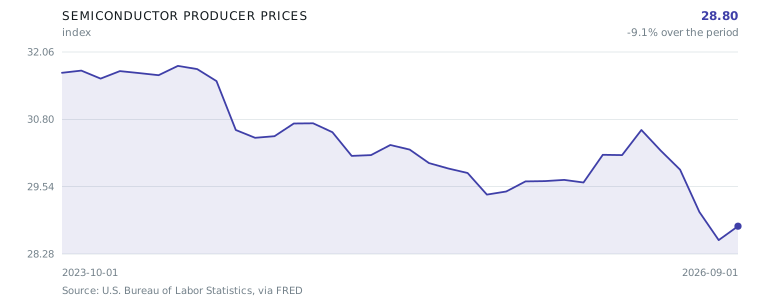
Three instrument readings add a colder layer. INFO_SECTOR_EMP recorded a value of 2739 on 1 September 2026. ELEC_PRICE recorded 0.196 on the same date. SEMI_PPI recorded 28.472 on 1 August 2026. These are not consumer anecdotes. They are dashboard entries.
The comparison is limited. The employment figure, 2739, is a level beside the electricity price, 0.196, and both are dated a month after the semiconductor PPI reading of 28.472. Without a prior period, none of the three shows acceleration. The dashboard is static, not a trend. They can suggest where activity sits, not whether it is improving or straining.
That is the open question for China’s consumer AI and e-commerce push. Scale can be announced before it can be served. The market will settle it in mundane terms: uptime during peak traffic, refund speed when systems fail, and whether the economic instruments move together when the festival load arrives.
- 01DeepSeek’s services suffered a nearly five-hour outage on Thursday.
- 02DeepSeek offered refunds or compensation after the outage.
- 03Alibaba is preparing for Singles’ Day on Taobao and Tmall.
- 04The available account puts participating brands at one million.
- 05SEMI_PPI recorded 28.472 on 1 August 2026.
Interpretation, not reporting. The facts above carry their tiers; this is one correspondent’s reading of them.
The useful signal is not that China’s consumer AI and e-commerce are large; it is that the proof points are still thin. I see three levels: Alibaba’s one-million-brand figure is a scale story, not audited merchant data; the rush to learn AI is a social mood, not an enrollment table; and DeepSeek’s nearly five-hour outage is the clearest operational fact in the set. The refunds matter because they show a commercial response, but they do not prove the underlying system is resilient. The instrument readings — INFO_SECTOR_EMP at 2739, ELEC_PRICE at 0.196 and SEMI_PPI at 28.472 — add texture, yet without prior periods they cannot show momentum. If Alibaba’s festival traffic and AI usage stay high, the next test will be boring: uptime, refund speed, customer support and power costs. If those hold, the scale story becomes credible. If they wobble, the headline number will look like marketing.
— Magnus Ebbesen
Every claim in this article, and what it rests on
We do not ask you to take our word for it. Each statement below carries its tier and its sources. Where sources disagree, you get both accounts and what would settle it.
The INFO_SECTOR_EMP instrument recorded a value of 2739 for 2026-09-01.
The ELEC_PRICE instrument recorded a value of 0.196 for 2026-09-01.
The SEMI_PPI instrument recorded a value of 28.472 for 2026-08-01.
Alibaba Group Holding is preparing for its annual Singles’ Day shopping festival on Taobao and Tmall.
One million brands are joining Alibaba’s Singles’ Day festival.
DeepSeek’s services suffered a nearly five-hour outage on Thursday.
DeepSeek offered refunds or compensation to users after the outage.
Millions of people across China are rushing to learn AI.
The case against this story
Written by an adversarial reviewer, not the correspondent
The story assembles a flattering portrait of China's tech and consumer economy from loosely connected pieces. The claim that one million brands are joining Alibaba's Singles' Day festival relies on a suspiciously round number that mirrors corporate marketing language rather than independently verified merchant-registration data. The assertion that millions of people across China are rushing to learn AI is vague hyperbole with no quantified source—no enrollment figures, no platform-download statistics, no survey results. The DeepSeek outage is presented as a clean, nearly five-hour incident with prompt refunds, framing what could be a more serious reliability failure as a well-managed blip. Meanwhile, three economic instrument readings—employment, electricity price, and semiconductor PPI—are cited as precise decimal values without naming their source datasets, making them indistinguishable from plausible-sounding fabrications. Two of these readings purport to cover September 2026, data that may not even be publicly released yet as of mid-October. Taken together, the narrative constructs an image of a thriving, dynamic Chinese tech ecosystem—booming e-commerce, AI enthusiasm, robust economic indicators—that leans heavily on unverified corporate claims, hyperbolic generalizations, and unsourced data points.
Who benefits from this framing: Alibaba benefits from the one-million-brands figure being treated as fact rather than marketing, amplifying the perceived scale and momentum of its Singles' Day festival. DeepSeek benefits from its outage being framed as a brief, well-handled incident with prompt compensation rather than a potential signal of infrastructure fragility. Chinese tech-sector promoters and state-aligned media benefit from the millions-learning-AI narrative, which burnishes China's AI ambitions without requiring evidence. If the economic instrument readings are favorable or selectively chosen, entities promoting China's economic competitiveness benefit from their presentation as authoritative, precise data points rather than unsourced numbers.
Report an error in this article
Subscriptions open at launch
Future Systems Review will be a paid publication. Reading is free while we build the archive — leave an address and we will write to you once, when subscriptions open.