
China’s AI export proposal hardens the tech border
Draft controls and a planned smuggling offence raise compliance costs before any chip is stopped.
 Rafael ImaiCompute, chips and power

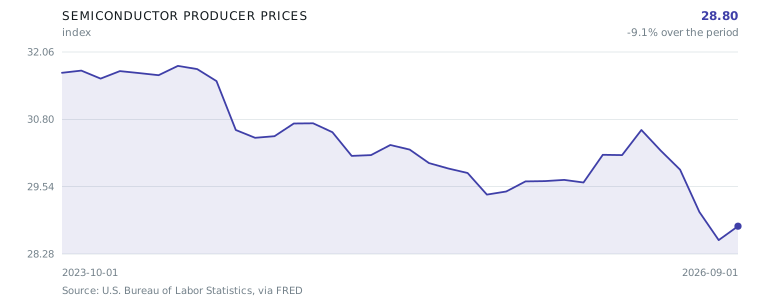
China has proposed export bans and controls on AI technologies, with the draft said to cover 40 technologies. Taiwan is about to make smuggling Nvidia chips into China a crime, while Huawei is said to have passed a 100 million Kirin chip milestone. The semiconductor producer price index was 28.801 on 1 September, but a single reading does not show a trend.
China’s proposed AI export controls and Taiwan’s move against chip smuggling do not yet form a single wall. They are separate gates, still being hung, and each one changes the cost of moving technology across the Taiwan Strait. The semiconductor producer price index was 28.801 on 1 September. That number is a point, not a slope: without a prior series, it cannot tell whether prices are firming, easing or simply being re-based.
Paperwork comes before the border
China has proposed export bans and controls on artificial intelligence technologies. The draft is said to cover 40 technologies, including AI. The important word is proposed. A proposal can move through consultation, shrink in scope, sit in a ministry for months or emerge with different licensing terms. For companies, the near-term effect is not a hard prohibition but a new compliance question: can an AI model, design file, toolchain or technical service cross the border without triggering a review?
That question has a physical shadow. Export controls on software can look weightless, but they land on hardware, engineering teams and customs paperwork. If a control applies to AI-related technology, the bottleneck shifts from the algorithm to the process of proving where it came from, who trained it, what hardware touched it and whether a licence is required. Lead times lengthen before any shipment is stopped.
The market signal is therefore procedural. A draft list of 40 technologies matters less than the eventual definition of controlled items, the licensing authority and the penalties for re-export. Until those are fixed, the border is a legal risk, not a closed gate.
Until those are fixed, the border is a legal risk, not a closed gate.
Taiwan’s enforcement aims at the grey channel
Taiwan is about to make smuggling Nvidia chips into China a crime, in the next step described. That is a different instrument from export controls. It targets diversion: goods that leave one jurisdiction legally but arrive in another through false paperwork, trans-shipment or small-lot trafficking. Criminal law changes the behaviour of freight forwarders, brokers and warehouse operators, because it raises the personal and corporate cost of being caught.
The mechanism is enforcement, not design. If chip smuggling becomes a criminal offence, the state can pursue intermediaries, seize goods and demand records. That makes the grey channel more expensive. Rerouting through third countries may still happen, but each extra leg adds time, margin and audit risk. For high-value chips, the result is not necessarily scarcity; it can be a wider spread between compliant and non-compliant prices.
This also explains why the Nvidia name matters. It points to a specific class of high-value chips that are easy to move and expensive to replace. A law aimed at smuggling does not create new chips, but it can change who is willing to touch them.
Huawei’s milestone is volume, not proof of the edge
Huawei is said to have passed a 100 million Kirin chip milestone. That is a large number, and it sits beside the fact that Huawei was once hobbled by US sanctions. The milestone shows persistence. It does not, by itself, show that the chips are leading-edge, that yields are high, that the process is economically repeatable, or that the parts are not concentrated in older nodes.
In semiconductors, volume and capability are different problems. A company can ship many chips on older processes while still lagging at the frontier. A milestone can also reflect stockpiling, design reuse or a captive market that accepts lower performance because alternatives are restricted. The relevant question is not only how many chips were made, but what they cost to make, how much power they draw, and whether they can be produced in the next million units without special relief.
The price index adds little context on its own. A reading of 28.801 on 1 September is useful only when placed against earlier readings, input costs and capacity utilisation. Without that series, it is a label, not a trend. The stronger picture is therefore not a sudden, coordinated escalation, but a set of incomplete moves: a Chinese proposal, a Taiwanese legal step that has not yet arrived, and a Huawei production figure that says volume without saying competitiveness.
The thing to watch is whether the paperwork becomes enforceable. If China’s draft narrows into a published rule and Taiwan’s smuggling offence moves from preparation to prosecution, the tech border will harden in practice. If not, today’s signals may remain bargaining chips.
- 01China has proposed export bans and controls on AI technologies.
- 02The draft is said to cover 40 technologies, including AI.
- 03Taiwan is about to make smuggling Nvidia chips into China a crime.
- 04Huawei is said to have passed a 100 million Kirin chip milestone.
- 05The semiconductor producer price index was 28.801 on 1 September.
Interpretation, not reporting. The facts above carry their tiers; this is one correspondent’s reading of them.
The hard part of this story is the gap between announcement and enforcement. I see three separate levers: a Chinese export-control proposal said to cover 40 technologies, a Taiwanese move that is about to criminalise Nvidia-chip smuggling, and a Huawei milestone of 100 million Kirin chips. None of them, on its own, proves a closed technology border. The proposal can be narrowed or delayed; the law has not yet bitten; the chip count says nothing about leading-edge performance. I would treat the semiconductor producer price index reading of 28.801 on 1 September as a placeholder until a series gives it direction. The more useful question is whether compliance becomes expensive enough to reroute real flows. If published rules and prosecutions follow, the cost of moving AI-related technology will rise through paperwork and delays. If they do not, today’s hardening may remain mostly rhetorical.
— Rafael Imai
Every claim in this article, and what it rests on
We do not ask you to take our word for it. Each statement below carries its tier and its sources. Where sources disagree, you get both accounts and what would settle it.
The semiconductor producer price index was 28.801 on 2026-09-01.
China has proposed export bans and controls on artificial intelligence technologies.
The proposed Chinese export controls cover 40 technologies, including AI.
Taiwan is about to make smuggling Nvidia chips into China a crime.
Huawei passed a 100 million Kirin chip milestone.
Huawei was once hobbled by US sanctions.
The case against this story
Written by an adversarial reviewer, not the correspondent
The story's overall picture is one of decisive, coordinated escalation: China imposing AI export controls, Taiwan criminalizing chip smuggling, Huawei hitting production milestones, and semiconductor prices hitting a specific level. But every pillar is softer than it appears. China has 'proposed' controls—proposals routinely stall, get watered down, or never become law. Taiwan is 'about to' criminalize smuggling—meaning it has not yet done so. Huawei 'passed a 100 million Kirin chip milestone'—but volume says nothing about whether those chips are competitive at the leading edge or are legacy-process parts stockpiled under sanctions. And the semiconductor producer price index figure is a lone number with no series context, no comparison to prior months, and no named source. The story assembles tentative, incomplete, and unverified developments into a narrative of inexorable tech-war escalation, when the actual evidence supports at most a picture of uncertain, incremental moves whose outcomes are far from settled.
Who benefits from this framing: National security hawks and defense policymakers who want to portray China as an escalating threat requiring tighter countermeasures and higher defense spending. Domestic semiconductor companies and industry lobbyists seeking subsidies, export protection, or favorable trade policy by pointing to Chinese advances. Politicians who benefit from stoking a China-threat narrative to justify legislation. Nvidia's competitors, who gain if restrictions on Nvidia chip flows to China tighten further. Anyone with a short position in Chinese tech equities or a long position in US defense and semiconductor stocks, since the framing amplifies fear of disruption and decoupling.
Report an error in this article
Subscriptions open at launch
Future Systems Review will be a paid publication. Reading is free while we build the archive — leave an address and we will write to you once, when subscriptions open.