
China’s chip export surge meets an IPO test
Reported export growth, YMTC signals and an Apple approval turn opaque capacity talk into testable commercial evidence.
 Ines KovačFrontier models and AI agents

Reported September integrated-circuit exports jumped 136% year on year to US$45 billion, with AI demand credited for pushing up prices. YMTC is described as nearing an IPO and expected to grow revenue six times faster than peers, while Alibaba’s models were approved for Apple handsets. The result is a rare set of commercial signals, but their scale and sourcing need careful verification.
China’s integrated circuit exports rose 136% year on year in September and totalled US$45 billion, according to reported figures, a monthly total that annualises to about US$540 billion. The same reporting attributes the jump to AI demand pushing up prices. Taken together, those numbers would turn China’s semiconductor story from capacity talk into a commercial surge that can be tested against later disclosures and filings.
They also create a test. A 136% increase in one month is not a normal drift in a large, mature manufacturing sector. If the figure is value-based, the scale demands an explanation of what is included. If it is volume-based, the price explanation becomes more important. The available details do not resolve that distinction, so the strongest reading is provisional: these are signals to verify, not proof by themselves.
Prices are doing part of the work
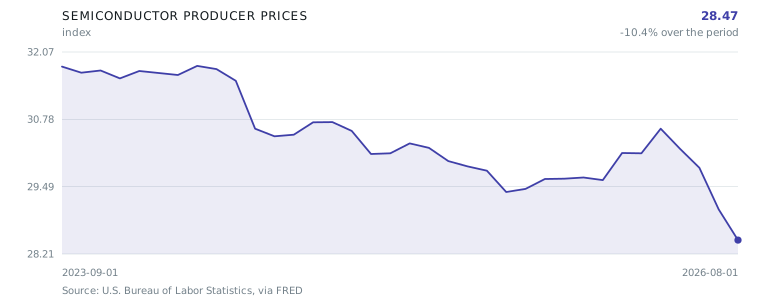
The semiconductor producer price index was 28.472 on 1 August. An index level on its own does not say whether prices are rising quickly, slowly, or at all; the change over time and the base of the series are what give it meaning. But the reported export explanation points in the same direction: AI demand is being credited with lifting prices, not merely increasing the number of chips shipped.
The next test is whether audited filings and repeatable trade data make the September numbers look ordinary.
That matters because price-led growth changes the commercial picture. A factory can report much higher revenue without proportionally higher capacity, if the mix shifts toward scarcer or more valuable parts. It also makes the export figure more sensitive to a few high-value categories. For investors, the question is not only whether China is shipping more semiconductors, but whether the reported September number reflects durable demand or a short price spike.
YMTC’s IPO turns the story into a valuation question
YMTC, described as China’s leading flash-memory maker, is nearing an IPO, according to a report. The reported account also expects the company to grow revenue six times faster than its industry peers. Those are two different kinds of signal: one is a process milestone, the other is a performance forecast. The first can be confirmed by listing documents; the second needs a peer set, a period and a method.
The IPO context is why the export numbers matter beyond trade statistics. If AI demand is raising chip prices, a flash-memory maker can present a growth story just as public-market investors are being asked to price it. Revenue that grows faster than peers is easier to sell if it is tied to a visible industry tailwind. But “six times faster” is a heavy assertion without the comparison group, the period, or the accounting basis. Until a prospectus or audited financials put numbers under it, it belongs in the category of market narrative rather than operating fact.
Apple approval adds a consumer channel
China approved Alibaba Group Holding’s AI models for use in the iPhone Duo and other Apple handsets, according to the reported account. That is a different kind of evidence from export totals. It points to a specific deployment path: models running on consumer devices sold in China, subject to regulatory approval and commercial integration.
The handset approval does not prove revenue, usage or performance. It does show that at least one large AI stack has moved through a regulatory gate and into a global hardware platform. For a market often judged by benchmarks and capacity talk, a phone approval is a mundane but useful signal: someone had to sign off, integrate, and accept the risk of shipping.
The open question is whether these threads connect. Export data, a price index, an IPO timetable and a handset approval can all point to the same conclusion: China’s AI and chip stack is beginning to generate commercial evidence. They can also remain separate: a price spike, a listing window, and a regulatory clearance that do not add up to a durable industry shift. The next test is whether audited filings and repeatable trade data make the September numbers look ordinary.
- 01Reported September integrated-circuit exports rose 136% year on year to US$45 billion.
- 02The export rise was attributed to AI demand pushing up prices.
- 03The semiconductor producer price index was 28.472 on 1 August.
- 04A report says YMTC is nearing an IPO, and the reported account expects revenue growth six times faster than peers.
- 05China approved Alibaba’s AI models for the iPhone Duo and other Apple handsets.
Interpretation, not reporting. The facts above carry their tiers; this is one correspondent’s reading of them.
The useful part of this story is not the size of the export number; it is that the number can now be challenged. I would separate three signals. The Apple approval is a deployment fact, even if it says nothing about sales. The YMTC IPO report is a process fact, but the six-times-peer growth figure is a valuation story until a peer set and period are disclosed. The export figures sit in between: 136% growth and US$45 billion in one month are large enough to require a clear definition of value, scope and product mix. If the September surge survives scrutiny in later trade data and IPO filings, it will point to price-led demand rather than simple capacity expansion. If it does not, the more durable signal may be the handset approval, because it forces integration, compliance and shipping discipline. The market is being asked to price a chip boom before the audit.
— Ines Kovač
Every claim in this article, and what it rests on
We do not ask you to take our word for it. Each statement below carries its tier and its sources. Where sources disagree, you get both accounts and what would settle it.
The semiconductor producer price index was 28.472 on 2026-08-01.
China approved Alibaba Group Holding's AI models for use in the iPhone Duo and other Apple handsets.
YMTC is China's leading flash-memory maker.
A report says YMTC's IPO is nearing.
YMTC is expected to grow revenue six times faster than its industry peers.
China's integrated circuit exports rose 136% year on year in September.
China's integrated circuit exports totaled US$45 billion in September.
The rise in China's chip exports was attributed to AI demand pushing up prices.
The case against this story
Written by an adversarial reviewer, not the correspondent
The story's core numbers are historically implausible and internally inconsistent. US$45 billion in monthly chip exports would annualize to over half a trillion dollars, multiples of any known historical level. 136% year-on-year export growth, if in value terms, is unprecedented for a mature manufacturing sector. The semiconductor producer price index figure of 28.472 does not match standard base-100 index formats or YoY percentage-change reporting. The claim that YMTC is expected to grow revenue six times faster than its industry peers is an extraordinary assertion presented without source or methodology. The 'iPhone Duo' product name is unrecognized. Together these create a maximalist bullish narrative about China's semiconductor industry that appears designed to hype rather than inform, particularly around YMTC's IPO.
Who benefits from this framing: YMTC and its IPO underwriters benefit directly from the narrative of a nearing IPO and explosive revenue growth. Chinese semiconductor companies and their investors benefit from inflated export figures that suggest sector dominance. Alibaba benefits from the story that its AI models have been approved for Apple handsets, boosting its AI credibility. The overall framing attracts investment capital to China's chip ecosystem at a time when YMTC is seeking public market funding.
Report an error in this article
Subscriptions open at launch
Future Systems Review will be a paid publication. Reading is free while we build the archive — leave an address and we will write to you once, when subscriptions open.