
China's chip push leans on an EUV prototype and a party chief's visit
Investors need to know whether Beijing can localize advanced lithography and memory capacity, but the evidence is still thin.
 Rafael ImaiCompute, chips and power
Anhui's new Communist Party secretary is reported to have made a chip-industry inspection and backed CXMT, while a start-up says it has an EUV light-source prototype. Three indicator readings offer a limited macro snapshot. The political backing is visible; the technical and commercial proof is not.
Anhui's new Communist Party secretary is reported to have made a chip-industry visit three weeks into the role, and the timing has been read as a signal of priority. Accounts of the inspection say Li Lecheng pledged support for CXMT and vowed to expand the sector. In China's system, that kind of attention can matter: it can speed permits, align provincial financing, and turn a company's capacity plan into local government work. The political signal is easier to verify than the technology.
The more striking assertion comes from a Chinese start-up, which says it has unveiled a prototype extreme ultraviolet light-source machine. The account describes the component as the heart of advanced lithography. If the assertion holds, it would address one of the hardest bottlenecks in chipmaking. But a prototype is not a fab-ready tool. It does not prove yield, uptime, cost control, or the ability to repeat the process thousands of times a day.
A provincial visit is not a production line
The inspection and the pledge matter because they point to the channel through which Beijing often pushes industrial goals: provincial responsibility, state-backed customers, and coordinated support for named champions. CXMT is the company named in the pledge, so support for it is not symbolic only. It can mean land, power, water, credit, and local supply-chain recruitment. Those are the physical inputs that turn a plan into capacity.
Yet routine inspections can also be routine. A newly appointed provincial leader visiting a key industry three weeks after taking office may be showing continuity rather than announcing a breakthrough. The timing adds narrative neatness, but it does not by itself show that Anhui's chip line is moving faster than it was before the visit.
The political signal is easier to verify than the technology.
Three numbers, one thin dashboard
The available indicators give a small dashboard, not a full audit. The SEMI_PPI series was 28.472 on 1 August, a month before the other two readings. INFO_SECTOR_EMP was 2,739 on 1 September, a headcount-style figure rather than a price. ELEC_PRICE was 0.196 on the same September date, a small unit reading next to the larger semiconductor gauge.
Those figures can be read in two ways. One is that the sector has enough activity to show up in employment and power use, while semiconductor prices or activity remain elevated relative to a low electricity-price baseline. The other is that three isolated points do not reveal trend, causality, or whether the readings reflect official statistics, estimates, or a narrower industry sample. Without a longer series, they support observation, not conclusion.
The EUV prototype needs hard proof
The EUV light-source assertion is the piece that could change the story. Advanced lithography depends on a source that can produce extreme ultraviolet light reliably, and the account describes the component as the heart of the system. A prototype would be an early step toward reducing dependence on foreign tools. If it works, it changes the math around localization, because the bottleneck is not just acquiring equipment but making it run.
But the burden of proof is high. EUV is not a single invention; it is a chain of precision optics, plasma physics, materials, contamination control, and service ecosystems. A start-up can demonstrate a light source in a lab and still be years from a machine that a memory or logic fab would trust for volume production. The assertion should be treated as a milestone to verify, not as capacity already delivered.
The practical test will be mundane. Can the source run long enough? Can it be maintained? Can it be paired with optics, masks, resists, and metrology? Can a fab use it without losing yield? Until those questions have answers, the Anhui visit and the prototype assertion are best seen as direction and ambition, not proof of localization.
The open question is whether Beijing can convert political backing into a repeatable manufacturing capability. The indicators, the inspection, and the EUV prototype all point in the same direction, but they do not yet show the destination.
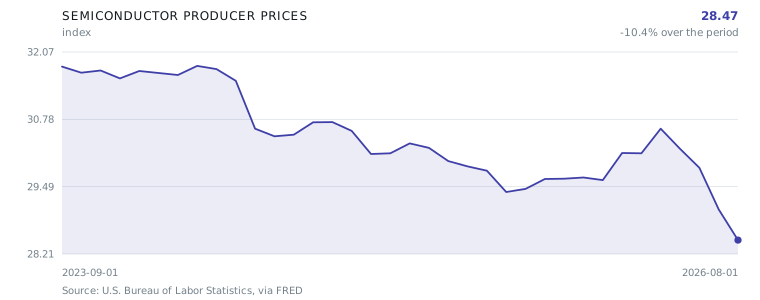
- 01SEMI_PPI was 28.472 on 1 August.
- 02INFO_SECTOR_EMP was 2,739 on 1 September.
- 03ELEC_PRICE was 0.196 on 1 September.
- 04Accounts say Li Lecheng backed CXMT during an Anhui chip-industry inspection.
- 05A start-up says it has unveiled an EUV light-source prototype.
Interpretation, not reporting. The facts above carry their tiers; this is one correspondent’s reading of them.
The bottleneck in China's chip effort is not political will; it is repeatable physics. Anhui's inspection of CXMT and the promise to expand the industry show where provincial support is heading. The three indicators give a limited snapshot: SEMI_PPI at 28.472 on 1 August, INFO_SECTOR_EMP at 2,739 on 1 September, and ELEC_PRICE at 0.196 on the same September date. I would treat those as context, not proof. The EUV light-source prototype is the decisive item, because the component is described as the heart of advanced lithography. If it can run reliably, it narrows one part of the localization gap. If it cannot survive a fab's uptime and contamination demands, it remains a lab milestone. I would watch for maintenance intervals, yield data, and whether a memory or logic line will qualify it. Political visits can buy time, land and permits; they cannot buy a stable plasma source.
— Rafael Imai
Every claim in this article, and what it rests on
We do not ask you to take our word for it. Each statement below carries its tier and its sources. Where sources disagree, you get both accounts and what would settle it.
The INFO_SECTOR_EMP indicator was 2739 on 2026-09-01.
The ELEC_PRICE indicator was 0.196 on 2026-09-01.
The SEMI_PPI indicator was 28.472 on 2026-08-01.
Li Lecheng was three weeks into his role as Communist Party secretary of Anhui province when he carried out an on-site inspection tied to China’s chip industry.
Li Lecheng pledged support for CXMT and vowed to expand the chip industry.
A Chinese start-up unveiled a prototype extreme ultraviolet (EUV) light-source machine.
The EUV light-source component is described as the heart of advanced lithography.
The case against this story
Written by an adversarial reviewer, not the correspondent
The story weaves together a newly appointed provincial party secretary's inspection, a start-up's purported EUV light-source prototype, and three economic indicators to construct a narrative of China's chip industry advancing rapidly under top-level political backing. The most extraordinary assertion—that a Chinese start-up unveiled a prototype extreme ultraviolet light-source machine—demands extraordinary evidence. EUV lithography is among the most complex technologies ever developed; ASML, the sole commercial producer, required over two decades and billions of euros in investment, and a start-up prototype would be a watershed moment in global semiconductor history. Even at a lower confidence tier, such a claim carries enormous narrative weight. The story also implies a causal link between a political inspection and industry progress that may simply be coincidental—newly appointed officials visiting key industries is routine in China. The precise timing detail (three weeks into the role) adds a veneer of narrative tightness that may not reflect reality. Meanwhile, the three economic indicators, if not drawn from official statistical releases, could be estimates or projections whose connection to the EUV and inspection claims is unclear, yet their inclusion at the highest confidence tier lends the overall story an air of quantitative authority it may not deserve.
Who benefits from this framing: Chinese state interests seeking to project technological self-sufficiency and reduce perceived vulnerability to Western export controls benefit directly from this framing. Investors in Chinese semiconductor companies could see valuations rise on news of an EUV breakthrough and high-level political support. Western advocates of harder export controls or decoupling can point to Chinese advances as justification for stricter measures. Chinese semiconductor firms seeking government subsidies, political backing, or international investment benefit from demonstrating breakthrough capabilities. Provincial officials and party figures also benefit by appearing to drive industrial advancement, burnishing their career credentials within the party system.
Report an error in this article
Subscriptions open at launch
Future Systems Review will be a paid publication. Reading is free while we build the archive — leave an address and we will write to you once, when subscriptions open.