
CXMT’s earnings story meets a paper-trail test
Memory investors are moving from sector exposure to proof, and a strong headline is only useful if it can be filed, funded and priced.
 Rafael ImaiCompute, chips and power

A circulating market account says CXMT delivered blockbuster earnings, forecast strong profits and planned a buyback, yet its shares fell more than 8%. The real test is whether that narrative can be tied to filings, because memory investors are no longer rewarding exposure alone.
The market’s version of ChangXin Memory Technologies’ Monday is tidy: blockbuster earnings, a strong profit forecast, a buyback and a share price that fell more than 8% anyway.
That is the kind of divergence that usually forces a question about quality. If investors do not reward a beat, they are either doubting the numbers, the guidance, or the vehicle through which they are being delivered.
CXMT is a Chinese memory-chip company, and that identity is enough to place it inside one of the most closely watched trades in hardware. Memory has become a proxy for AI infrastructure, so every margin signal gets read through capacity, pricing and future orders.
A rally that wants paperwork
The problem with the current story is that the market-moving pieces are floating. A share-price decline needs a listed share. An earnings beat needs a reported set of accounts. A forecast needs a guidance statement. A buyback needs a board announcement and a mechanism.
The omission is not a small formatting issue. Market participants price not only the direction of a business but the reliability of the channel that delivers the information. If the channel is unclear, the risk premium goes up even when the headline is positive.
In the account circulating, none of those anchors is specified. Without a filing, a share-price move is just a percentage attached to a name.
Without a filing, a share-price move is just a percentage attached to a name.
That matters because a buyback is not only a signal; it is a set of transactions. It requires cash, authorization, timing and a market in which shares can be repurchased. If those details are not visible, the buyback functions as sentiment rather than capital.
The same applies to the fall of more than 8%. A move of that size is often treated as information, but without an exchange, a filing or a corporate announcement, it is only a number with momentum.
Early trading can exaggerate a move, but it can also reveal how little conviction is attached to a headline. When a fall comes immediately after a supposedly strong print, the market is either discounting the print or trading the uncertainty around it.
Memory exposure is no longer enough
The wider pressure point is the sector itself. Investors have been willing to pay for memory exposure when supply was tight and prices were rising. The test now is whether companies can convert that exposure into durable margins.
Memory names are no longer moving as one basket. The market is starting to distinguish between margin proof and corporate-action risk, which means a strong sector label is not enough to carry every name.
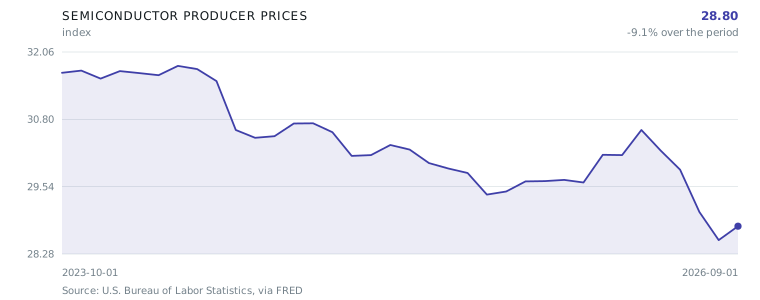
For CXMT, the immediate issue is narrower: can the strong-profit narrative be converted into a record that holders can underwrite? A semiconductor price index can show whether the cycle is doing some of the heavy lifting, but an index cannot substitute for company-level proof.
The market needs to know whether revenue is turning into operating profit, whether the forecast is backed by orders, and whether the buyback is funded. Those are operational questions, not sentiment questions.
This is the difference between a cycle story and a company story. A cycle can lift revenue without proving that a company controls its costs, its capacity decisions or its capital returns. A company story begins when those items can be inspected.
What would settle it
The simplest fix is mundane: an exchange filing, an earnings release, a guidance note, a buyback plan with size and dates. Until then, the story behaves like a trade in memory itself rather than a trade in a specific company’s audited performance.
The open question is not whether CXMT can produce a strong quarter. It is whether the market will be able to see the quarter in a form that can be priced.
- 01ChangXin Memory Technologies is a Chinese memory-chip company.
- 02The circulating account says CXMT shares fell more than 8% in early Monday trading.
- 03The same account describes the earnings as blockbuster.
- 04It also includes a forecast of strong profits and a planned share buyback.
Interpretation, not reporting. The facts above carry their tiers; this is one correspondent’s reading of them.
The market is shifting from memory scarcity to memory audit. I would not treat the 8% fall as the main fact; the main fact is that the story is being told without the paperwork that normally makes a share price meaningful. A blockbuster earnings figure, a strong profit forecast and a buyback are not interchangeable with proof. They become proof only when an investor can see the filing, the guidance and the repurchase mechanism. If those exist, the drop is a demanding market. If they do not, the drop is noise around a name. The lesson for hardware investors is that exposure to AI memory is no longer a thesis by itself. The trade now depends on margins, governance and the ability to follow the money. I would watch for one thing: whether the narrative is converted into documents. If it is, CXMT becomes a profit-quality story. If not, it remains a memory story with market color attached.
— Rafael Imai
Every claim in this article, and what it rests on
We do not ask you to take our word for it. Each statement below carries its tier and its sources. Where sources disagree, you get both accounts and what would settle it.
ChangXin Memory Technologies (CXMT) is a Chinese memory chip company.
CXMT shares fell in early Monday trading.
The decline in CXMT shares was more than 8%.
CXMT's earnings figures were described as blockbuster.
CXMT forecast strong profits.
CXMT planned a share buyback.
The case against this story
Written by an adversarial reviewer, not the correspondent
The entire narrative reads like a standard public-company earnings story—shares falling, an 8-percent price drop, 'blockbuster' earnings, a profit forecast, and a buyback plan—but no evidence is provided that CXMT is a publicly listed company at all. Every market-related claim in the story (share-price decline, percentage move, earnings description, profit forecast, buyback) depends on that listing status, and none of the five is anchored to a stock-exchange document, an earnings release, a guidance statement, or a buyback filing. If CXMT is not publicly traded, or if no such documents exist, the story collapses entirely: there are no shares to fall, no public earnings to call 'blockbuster,' no public forecast, and no exchange-traded buyback. Even if CXMT is listed, the absence of any cited source for the trading data, earnings figures, forecast, or buyback plan means the reader is asked to take each element on faith. The claim that CXMT is a Chinese memory-chip company is the only one that stands as a straightforward factual assertion; the rest form a chain that is only as strong as its missing links.
Who benefits from this framing: If a reader accepts this framing, those who benefit include: (1) market commentators or publishers who attract engagement by attaching dramatic financial narrative—a double-digit share-price drop, 'blockbuster' earnings, a buyback—to a company whose public-market status is unverified; (2) parties seeking to shape sentiment around Chinese semiconductor firms, either positively (by amplifying 'blockbuster' earnings and buyback signals) or negatively (by leading with an 8-percent share-price collapse), depending on what angle they wish to push; and (3) any trader or investor who could act on the appearance of a publicly traded, volatile CXMT before discovering that the underlying listing, earnings, forecast, or buyback may not be documented.
Report an error in this article
Read everything for 14 days, free
All three titles in full, the full daily brief, and an alert when a claim about something you follow changes. No card, and it ends by itself.