
DeepSeek and Kimi test whether Chinese AI users will pay
New model descriptions and a credit-card quota product show monetization experiments arriving before the export-lock question is settled.
 Ines KovačFrontier models and AI agents
DeepSeek has released an updated AI model that it describes as faster and more compact, while Moonshot AI’s Kimi AI credit card converts consumer spending into limited computing quotas. A Korean report adds a policy layer, saying Chinese AI is sold globally while the technology is not handed over. Three 1 September indicators — electricity at 0.196, semiconductor producer prices at 28.801 and information-sector employment at 2739 — show the cost and labor backdrop, not revenue.
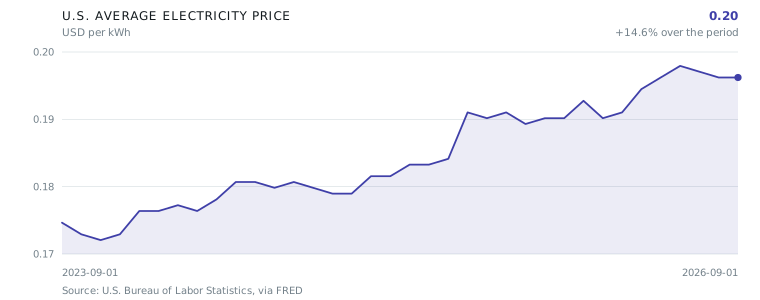
On 1 September, the electricity price indicator was 0.196. That is a small number, but for any company selling access to compute it sits close to the cost side of the ledger. On the same date, the semiconductor producer price index was 28.801, and the information-sector employment indicator was 2739. The three figures measure different things: power, chips and jobs, not revenue.
Into that setting comes a consumer-facing experiment. Moonshot AI’s Kimi AI credit card converts consumer spending into limited computing quotas, according to the product description. The mechanism is easy to state, even if the commercial result is not: card spending becomes a capped right to use compute. A quota is not a subscription, and a faster model is not a business model.
Quotas make compute feel like a utility
The Kimi card matters because it changes the unit of sale. Instead of asking a user to buy a standalone chatbot or an enterprise license, the product ties AI access to ordinary payment behavior. If a consumer spends, the consumer receives a limited amount of computing capacity. That turns inference into something closer to a metered allowance.
This also shifts the risk. When compute is sold as a quota, the company must manage the gap between the cost of serving the quota and the value the user assigns to it. Electricity is one input; semiconductor prices are another. The 1 September indicators do not show margins. They only show the cost and labor backdrop against which the billing test is happening.
A quota is not a subscription, and a faster model is not a business model.
DeepSeek’s update sits nearby. The company released an updated artificial-intelligence model and said it is faster and more compact. If those descriptions hold in ordinary use, a smaller, faster model could reduce the resources needed per query. That would matter to a quota product because each unit of compute would stretch further. But the available evidence stops at the company’s description.
The export-lock case is sharper than the proof
A Korean report says Chinese AI is sold globally while the technology is not handed over. That is a strong assertion, and it gives the story its policy edge. One reading sees a deliberate export-lock posture; the other sees separate commercial moves that do not establish technology-transfer controls.
The product announcements do not settle that question. A released model, a credit-card offer and three macro indicators can show commercial activity without showing a coordinated export-lock strategy. They also do not show whether customers outside China receive only services, or whether deeper technology transfers are blocked by contract, law or engineering. The Korean report’s framing and the consumer-billing experiments may point in the same direction, but the evidence does not yet connect them.
The broader commercial case is similarly incomplete. Chinese AI companies have spent years persuading consumers to pay for their technology, according to the framing attached to these updates. That may be true in some markets and not in others. The current announcements do not disclose how many users pay, how often they reload, or whether quotas create repeat demand.
The thing to watch is repeat behavior
The cleanest way to judge this phase is to separate three things: model capability, billing mechanics and policy restraint. DeepSeek is making a capability case. Kimi is testing a billing mechanic. The Korean report is making a policy case. Each can be true without the others adding up to a mature, coordinated system.
The next useful signal would be mundane. Does the credit-card quota produce recurring usage, or does it behave like a promotional bundle? Does a faster, more compact model actually lower serving costs in production? And does the export-lock description show up in observable license terms, or remain a broad characterization?
For now, the strongest fact is the simplest: Chinese AI firms are trying to put a price on compute in consumer terms. Whether that becomes durable revenue, or merely a clever way to ration expensive inference, is still open.
- 01DeepSeek released an updated AI model it describes as faster and more compact.
- 02Moonshot AI’s Kimi AI credit card converts spending into limited computing quotas.
- 03A Korean report says Chinese AI is sold globally while the technology is not handed over.
- 04The electricity price indicator was 0.196 on 1 September.
- 05The semiconductor producer price index was 28.801, and information-sector employment was 2739.
Interpretation, not reporting. The facts above carry their tiers; this is one correspondent’s reading of them.
The billing plumbing is more telling than the model adjective. DeepSeek’s description of a faster, more compact model is a performance pitch, but Kimi’s credit-card quota is an attempt to make compute purchasable in ordinary consumer terms. I would separate the three threads: capability, monetization and export control. The Korean report’s assertion that Chinese AI is sold globally while the technology is not handed over may prove important, but the available fragments do not yet show how it operates in contracts or product design. The indicators are also too thin to build a full macro case: electricity at 0.196, semiconductor producer prices at 28.801 and information-sector employment at 2739 are cost and labor markers, not proof of commercial success. If quotas generate repeat spending, the credit-card idea becomes a real monetization signal. If they do not, it looks like a way to ration expensive compute. The export-lock narrative will need harder evidence than a single report and a product launch.
— Ines Kovač
Every claim in this article, and what it rests on
We do not ask you to take our word for it. Each statement below carries its tier and its sources. Where sources disagree, you get both accounts and what would settle it.
The information-sector employment indicator was 2739 on 2026-09-01.
The electricity price indicator was 0.196 on 2026-09-01.
The semiconductor producer price index was 28.801 on 2026-09-01.
A Korean report says Chinese AI is sold globally while the technology is not handed over.
DeepSeek released an updated artificial-intelligence model.
DeepSeek said its updated AI model is faster and more compact.
Moonshot AI's Kimi AI credit card converts consumer spending into limited computing quotas.
Chinese AI companies have spent years persuading consumers to pay for their technology.
The case against this story
Written by an adversarial reviewer, not the correspondent
The story stitches together unrelated fragments — a DeepSeek model update, a Moonshot AI credit card product, a Korean report on technology transfer, and three economic indicators — into a narrative of Chinese AI commercial sophistication and technological protectionism, but the connections between these elements are never established. DeepSeek is widely known for open-sourcing its models, which directly contradicts the framing that Chinese AI technology 'is not handed over.' The claim about Moonshot AI's Kimi credit card converting spending into computing quotas is unusual and could be a loyalty program, a prepaid compute product, or something else entirely. The three economic indicators — information-sector employment at 2739, electricity price at 0.196, semiconductor producer price index at 28.801 — are presented as precise figures without any named statistical agency, making them impossible to verify independently. The broad assertion that Chinese AI companies have 'spent years' persuading consumers to pay conflates enterprise B2B sales, freemium consumer apps, and nascent monetization experiments into a single misleading arc. Taken together, the story implies a coordinated, mature Chinese AI commercial strategy that the individual claims — each weakly sourced — do not collectively support.
Who benefits from this framing: If readers accept this framing, they come away believing Chinese AI firms are commercially aggressive, monetizing through consumer products, and strategically withholding core technology. This benefits Western AI competitors and their investors who can cite this narrative to argue for protectionist measures, export controls, or sanctions against Chinese AI. It also benefits policymakers and lobbyists advocating for technology restrictions, who gain rhetorical support from a picture of Chinese AI as both threatening and opaque. Finally, it benefits non-Chinese AI companies seeking to justify their own market positioning or pricing by pointing to an apparently sophisticated and secretive Chinese rival.
Report an error in this article
Subscriptions open at launch
Future Systems Review will be a paid publication. Reading is free while we build the archive — leave an address and we will write to you once, when subscriptions open.