
EU’s first AI Act standard turns sovereignty into a checklist
A harmonised standard moves Europe’s AI ambition from political rhetoric into audits, procurement and vendor selection.
 Magnus EbbesenEnterprise adoption and technology policy

The Official Journal has published the first harmonised standard supporting the EU AI Act, according to an EU digital-policy record dated 19 October 2026. On the same day, tportal.hr asked whether Europe should abandon developing its own artificial intelligence. Three economic indicators recorded on 1 September lack baselines, so they cannot by themselves show a trend.
On 19 October 2026, a line in the Official Journal did more for Europe’s AI sovereignty than several years of speeches: it made a harmonised standard part of the AI Act’s compliance machinery. The EU digital-policy record for that publication is dated 19 October 2026 and identifies it as the first harmonised standard supporting the AI Act.
A standard is where policy gets teeth
That matters because standards are where policy becomes work. The AI Act sets obligations; a harmonised standard gives companies, auditors and buyers a recognised way to show that those obligations have been met. Once published in the Official Journal, the standard can be cited in contracts, audit files and procurement documents. It turns “European AI” from a slogan into a question with documents attached.
A harmonised standard turns sovereignty from a political ambition into a set of documents an auditor can request.
For vendors, the change is operational. Sales teams will have to say whether their systems are aligned with the standard, and buyers will ask for evidence. For public-sector procurement, the standard offers a common reference point, reducing the need for each agency to invent its own test. For investors, it clarifies one part of the risk picture: not whether AI is strategic, but which companies can survive an audit without rewriting their product. That distinction will matter when ministries write tenders and when auditors ask for proof.
A harmonised standard turns sovereignty from a political ambition into a set of documents an auditor can request.
A single question, not a European verdict
The same day, tportal.hr published an article asking whether Europe should abandon developing its own artificial intelligence. Its headline, “Europa na prekretnici”, frames Europe as being at a crossroads over the development of its own AI.
That is a real question, but it is not a policy decision. One outlet does not speak for the EU, and an article is not a withdrawal notice. The piece shows that the sovereignty debate is being argued in public, not that it has been resolved in either direction.
The danger is reading too much into juxtaposition. A regulatory milestone and a sceptical article can appear on the same day without forming one mood. Europe can publish a compliance standard while commentators ask whether the underlying ambition is worth the cost. Those are separate facts, and they do not need to be stitched into a single verdict.
Numbers without a direction
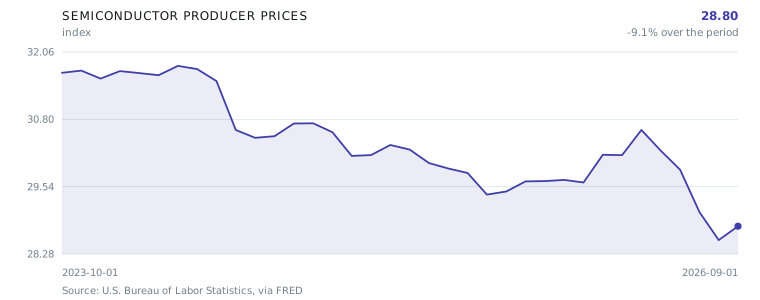
Three economic indicators recorded on 1 September 2026 are easy to misread. Information-sector employment stood at 2,739, with no earlier figure in the record for comparison. The electricity price indicator was 0.196, without a reference price to show whether it is high or low. The semiconductor producer price index was 28.801, with no index base in the record.
Each could matter to AI adoption. Electricity prices affect the cost of running computation. Semiconductor prices affect the cost of buying hardware. Information-sector employment may show where labour is concentrated. But the figures do not say whether Europe’s position is improving or deteriorating. They are inputs to a cost model, not evidence of a trajectory.
That is the honest limit of the record. The standard can be checked against an audit list. The indicators cannot yet be used to say that Europe is winning or losing. The open question is whether procurement and budget decisions start to follow the standard, or whether the sovereignty debate stays rhetorical while buyers choose on price and performance.
- 01The Official Journal published the first harmonised standard supporting the EU AI Act.
- 02The EU digital-policy record is dated 19 October 2026.
- 03tportal.hr asked whether Europe should abandon developing its own AI on 19 October 2026.
- 04Information-sector employment was 2,739 on 1 September 2026.
- 05The electricity price indicator was 0.196 and the semiconductor producer price index was 28.801 on 1 September 2026.
Interpretation, not reporting. The facts above carry their tiers; this is one correspondent’s reading of them.
The compliance machinery is the real sovereignty story. I would not read the tportal piece as Europe changing course; it is a question, not a budget decision. What matters is that the first harmonised standard gives procurement officers a defensible answer when they ask whether a system fits the AI Act. That shifts power to auditors, standards bodies and buyers who can prove conformity. The bare indicators do not settle the economics. Electricity at 0.196, semiconductor producer prices at 28.801 and information-sector employment at 2,739 could matter, but without baselines they are numbers, not evidence. If European AI spending follows the standard, the bloc will have turned sovereignty into a marketable compliance product. If it does not, the standard will sit beside the debate rather than resolve it.
— Magnus Ebbesen
Every claim in this article, and what it rests on
We do not ask you to take our word for it. Each statement below carries its tier and its sources. Where sources disagree, you get both accounts and what would settle it.
The first harmonised standard supporting the EU AI Act was published in the Official Journal.
The EU digital-policy record for the Official Journal publication is dated 19 October 2026.
tportal.hr published an article on 19 October 2026 asking whether Europe should abandon developing its own artificial intelligence.
The information-sector employment indicator was 2,739 on 1 September 2026.
The electricity price indicator was 0.196 on 1 September 2026.
The semiconductor producer price index was 28.801 on 1 September 2026.
The EU digital-policy record identifies the publication as the first harmonised standard supporting the AI Act.
The tportal.hr article frames Europe as being at a crossroads over the development of its own artificial intelligence.
The case against this story
Written by an adversarial reviewer, not the correspondent
The story's overall picture stitches together three unrelated elements — an EU regulatory milestone, a Croatian portal's opinion piece questioning European AI development, and three economic indicators stripped of context — to imply a coherent narrative of European technological ambivalence: regulating while doubting itself. But this juxtaposition is manufactured. The tportal.hr article is a single Croatian outlet's perspective, not evidence of Europe-wide hesitation. The economic indicators (employment at 2,739, electricity price at 0.196, semiconductor PPI at 28.801) are presented as raw numbers with no baseline, no trend direction, and no units, making it impossible for a reader to assess whether they are high, low, improving, or deteriorating. The regulatory milestone and the opinion article may have no substantive connection beyond occurring on the same date. The 'first harmonised standard' claim appears twice — once as fact and once as what a record says — which looks like circular sourcing rather than independent confirmation. A reader receiving this as a coherent story about Europe's AI predicament is being shown a constructed narrative, not a naturally emerging one.
Who benefits from this framing: Those who benefit from this framing include deregulation advocates who can argue that Europe is regulating AI while simultaneously doubting its own capacity to build it — a narrative that makes regulation look premature or self-defeating. Non-European AI companies, particularly US and Chinese firms, benefit from perceptions of European technological weakness and regulatory self-sabotage. Political factions within Europe arguing against public investment in AI development also benefit, as the framing suggests domestic capability is a lost cause. Finally, anyone who wants to portray EU digital policy as bureaucratic overreach disconnected from industrial reality benefits from a story that pairs regulatory process with doubt and context-free economic indicators.
Report an error in this article
Read everything for 14 days, free
All three titles in full, the full daily brief, and an alert when a claim about something you follow changes. No card, and it ends by itself.