
Georgieva’s AI stability warning needs more than three bare numbers
Investors must separate Georgieva’s growth and stability remarks from unsourced arguments about where AI profits pool.
 Ines KovačFrontier models and AI agents
Kristalina Georgieva has said artificial intelligence pushes growth and threatens global financial stability, but those two statements need separate evidence. Three instrument readings for 1 September are precise yet lack trend, unit or source context. The 68% design-share figure and one-hand profit argument remain unverified.
Three figures arrived for 1 September: 2739, 0.196 and 28.801. They are meant to describe the machinery around artificial intelligence — INFO_SECTOR_EMP, ELEC_PRICE and SEMI_PPI — but they arrive without a trend line, a unit in one case, or a comparison.
Kristalina Georgieva has said artificial intelligence pushes growth. She has also said it threatens global financial stability. Put together, those remarks frame the problem facing investors: the same technology can raise output and concentrate risk, and the market may not know which effect is dominant until after capital has moved.
The missing context matters. A level of 2739 for INFO_SECTOR_EMP cannot be read as expansion or contraction unless it is set against prior months. ELEC_PRICE at 0.196 needs a currency, a market and a baseline. SEMI_PPI at 28.801 needs an index base and a history. The numbers are precise; the story around them is not.
Design capture is plausible, but not yet proven
The more ambitious figure is that 68% of value added in artificial intelligence goes to companies that hold the design. If true, that would mean the economics of AI resemble a platform or patent model more than a commodity manufacturing chain: scarce intellectual property takes the margin, while others supply labour, power or capacity.
The numbers are precise; the story around them is not.
But the figure is not tied to a named report, a year, a methodology or a definition of value added. It also sits beside a broader assertion that huge AI profits are concentrated in one hand, which compresses a possible oligopoly into a single holder. Those are different statements. One is about market structure; the other is rhetorical.
A third argument says the production burden is located in developing countries. That, too, needs a map. AI production includes chip fabrication, server assembly, data-centre construction, power supply, model training, annotation and maintenance. Each stage has different capital intensity, different geography and different margins. Without segment-level data, the burden argument is a slogan, not a ledger.
Stability is the harder variable
Georgieva’s stability warning is the part that can move policy. Financial-stability risk does not require AI profits to be unjust; it only requires leverage, correlated bets or sudden repricing. If lenders, landlords, utilities and funds are all exposed to the same build-out, a slowdown in AI investment can travel beyond the sector.
But again, the mechanism needs numbers. Are data-centre projects financed with debt? Are power contracts priced off the 0.196 electricity figure? Are semiconductor prices, at 28.801, rising enough to squeeze downstream buyers? Without those links, the warning remains a direction, not a magnitude.
What to watch instead
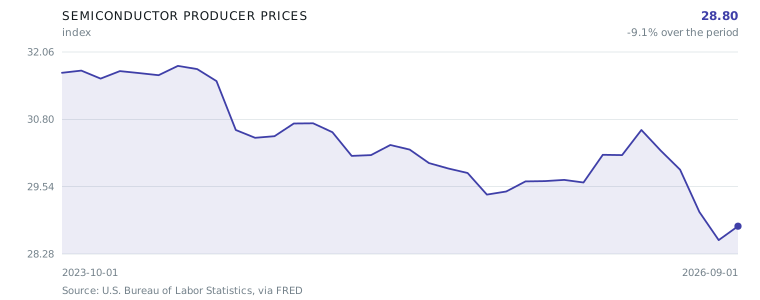
The practical test is whether the three instruments can be turned into a time series. INFO_SECTOR_EMP should show whether AI-related employment is broadening or peaking. ELEC_PRICE should show whether compute demand is feeding through to power costs. SEMI_PPI should show whether hardware input costs are falling, stable or spiking.
Until then, the strongest available facts are narrow: Georgieva has made both growth and stability statements, and three instrument levels exist for one date. The 68% design-share figure, the developing-country production burden and the one-hand profit argument remain unverified. For a market trying to price AI, that distinction is the difference between a thesis and a rumour. The next useful disclosure would be a sourced breakdown of AI value added by function, owner and geography. It would also say whether design, fabrication, power and labour are being counted in the same currency.
- 01INFO_SECTOR_EMP was 2739 on 1 September.
- 02ELEC_PRICE was 0.196 on 1 September.
- 03SEMI_PPI was 28.801 on 1 September.
- 04Georgieva said AI pushes growth and threatens global financial stability.
- 05The 68% design-share and one-hand profit figures are not tied to a named source.
Interpretation, not reporting. The facts above carry their tiers; this is one correspondent’s reading of them.
The real risk in this story is not that AI is exploitative; it is that the ledger is missing. I can accept Georgieva’s two statements as separate signals: growth on one side, stability on the other. But I cannot turn 2739, 0.196 and 28.801 into a position without history, units and comparators. The 68% design-share figure has the shape of a conclusion without the discipline of a methodology. The production-burden argument is even thinner, because AI’s chain has stages with very different capital intensity and geography. If future disclosures attach the instrument levels to a time series and source the value-added split, the concentration thesis becomes testable. If they do not, the better description is not scandal but uncertainty. My threshold is simple: show the function, the owner and the geography behind each number. Until then, I would treat the stability warning as a question for leverage and correlation, not as proof that one hand holds the profits.
— Ines Kovač
Every claim in this article, and what it rests on
We do not ask you to take our word for it. Each statement below carries its tier and its sources. Where sources disagree, you get both accounts and what would settle it.
The INFO_SECTOR_EMP instrument value was 2739 for 2026-09-01.
The ELEC_PRICE instrument value was 0.196 for 2026-09-01.
The SEMI_PPI instrument value was 28.801 for 2026-09-01.
Georgieva said artificial intelligence pushes growth.
Georgieva said artificial intelligence threatens global financial stability.
68% of value added in artificial intelligence went to companies that hold the design.
The production burden in artificial intelligence is located in developing countries.
Huge artificial intelligence profits are concentrated in one hand.
The case against this story
Written by an adversarial reviewer, not the correspondent
The story assembles a picture of AI as an engine of inequality: growth on one side, but concentrated profits, exploited developing countries, and financial instability on the other. Several pillars are weak. The claim that 68% of value added goes to design holders cites no report, and the assertion that profits are 'concentrated in one hand' is hyperbole that collapses the distinction between a handful of firms and a single entity. The production-burden claim ignores that the most capital-intensive and highest-value AI production stages — chip design and fabrication — occur in advanced economies, not developing ones. Georgieva is quoted as saying AI both pushes growth and threatens stability, but without context these may come from different speeches addressing different audiences, stitched together to imply a single coherent warning. The three instrument values are presented as bare numbers with no trend line, no comparison, and no stated source — a reader cannot tell whether they are high, low, rising, or anomalous. Taken together, the story arranges fragments into a predetermined narrative of AI-driven exploitation rather than letting evidence carry the argument.
Who benefits from this framing: Readers who accept this framing are primed to support aggressive AI taxation, profit redistribution, and technology-transfer mandates favored by developing-country negotiators and anti-corporate advocacy groups. The framing also benefits competitors to the implied AI profit-holders — whether rival firms, state-backed technology programs, or regulatory bodies seeking expanded mandates — by casting current AI leaders as monopolistic exploiters. Policy advocates pushing for industrial intervention, AI safety regulation, or digital sovereignty frameworks gain rhetorical ammunition from a story that portrays AI gains as illegitimately concentrated and its costs as offloaded to the poor.
Report an error in this article
Subscriptions open at launch
Future Systems Review will be a paid publication. Reading is free while we build the archive — leave an address and we will write to you once, when subscriptions open.