
Musk’s memory-pricing jab meets Korea’s record chip rally
Record chip earnings are colliding with public pricing pressure, a falling global semiconductor index and currency moves that can compress margins.
 Rafael ImaiCompute, chips and power
Korea’s semiconductor sector has reported record earnings, but Elon Musk’s reported criticism of Samsung and SK memory-chip pricing has added a public dispute to the trade. Korean chip shares have reportedly plunged while the Philadelphia Semiconductor Index falls, and the won’s strength could compress translated earnings. The key question is whether pricing power can outlast sentiment and currency pressure.
A pricing attack lands on a crowded trade
Elon Musk has reportedly criticised Samsung and SK memory-chip pricing, turning a normally technical market into a public dispute. The timing is awkward. Korea’s semiconductor sector has just reported record earnings, and an expert said Musk’s criticism runs counter to market logic.
The mechanism is expectations, not immediate invoices. Memory prices are set through contracts and spot markets, so a high-profile attack can pressure sentiment before it changes purchase orders. If buyers delay in hope of lower prices, suppliers could see negotiations harden. But if demand is strong enough to produce record earnings, the attack may remain noise.
The semiconductor producer price index stood at 28.801 on 1 September. That number, by itself, does not say whether chip prices are overheating or normalising; investors need a trend, a base period and a basket. It is a thermometer without a chart. Without context, the figure can be recruited into either the bull or the bear case, which is why the market’s reaction to it should be treated cautiously.
The market is selling the sector, not only Korea
Korean semiconductor share prices reportedly plunged while the Philadelphia Semiconductor Index reportedly continued to fall. That matters because it separates a Korea-specific story from a global one. When the sector benchmark declines, investors are often repricing chips everywhere, not punishing Samsung or SK alone.
The risk for Korean manufacturers is not that profits have disappeared; it is that the market no longer wants to pay the same multiple for those profits.
A falling index can also be profit-taking after a strong run. Record earnings tend to invite sellers, because good news is already in the price. The risk for Korean manufacturers is not that profits have disappeared; it is that the market no longer wants to pay the same multiple for those profits.
Musk’s comments add a political and commercial wrinkle. If memory pricing becomes a public issue, customers may demand concessions, or policymakers may ask questions. Yet the expert’s point stands: attacking supplier pricing in a market that has just delivered record results looks inconsistent with ordinary supply-demand logic.
Share prices, however, move faster than supply contracts. They can discount fear before any invoice changes hands. That is why the plunge is worth watching, but not yet proof that the pricing cycle has turned.
Currency is the quieter margin lever
The won/dollar exchange rate reportedly reached its lowest level in 25 months, and the won/yen exchange rate reportedly reached its lowest level in 18 years and 10 months. In plain terms, the won has been strong against both currencies. For exporters, that can compress the won value of overseas sales, even when volumes and contract prices hold steady.
This is where the margin risk becomes concrete. A chipmaker can report record earnings and firm memory prices, yet still see translated earnings shrink if the currency moves fast enough. The effect is mechanical and shows up in reported results with a lag.
The currency signal may also reflect global flows rather than a verdict on Korean chips. Central bank expectations and regional currency dynamics can move the won independently of Samsung’s or SK’s order books. That means the pressure is real, but it is not necessarily a chip-demand problem.
A stronger won can also change how Korean prices look against competitors paid in weaker currencies. That is a valuation question, not an operating one.
The open question is whether record earnings can absorb three simultaneous forces: a public pricing dispute, a falling global chip index and a stronger won. If pricing power holds, the earnings story survives. If it slips, the market will say it saw the turn first.
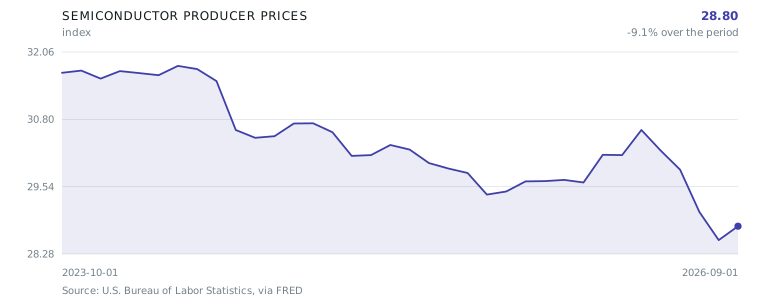
- 01The semiconductor producer price index was 28.801 on 1 September.
- 02Elon Musk reportedly criticised Samsung and SK memory-chip pricing; an expert said the criticism runs counter to market logic.
- 03Korea’s semiconductor sector reported record earnings.
- 04Korean chip shares reportedly plunged while the Philadelphia Semiconductor Index reportedly fell.
- 05The won/dollar rate reportedly reached its lowest level in 25 months; won/yen, in 18 years and 10 months.
Interpretation, not reporting. The facts above carry their tiers; this is one correspondent’s reading of them.
Record earnings are the hard fact; the share-price plunge is the market’s impatience. I would treat Musk’s criticism as a sentiment risk rather than proof that memory pricing has broken. An expert’s point that the attack runs counter to market logic matters because suppliers do not usually apologise for strong demand. The more mechanical pressure is currency: a won/dollar rate at its lowest level in 25 months and a won/yen rate at its lowest in 18 years and 10 months can reduce the won value of foreign earnings. The Philadelphia Semiconductor Index falling at the same time suggests a sector-wide repricing, not a Korea-only event. If pricing power survives the public dispute, the record results remain the controlling signal. If contract negotiations start to stretch, the market’s de-rating will look early rather than wrong.
— Rafael Imai
Every claim in this article, and what it rests on
We do not ask you to take our word for it. Each statement below carries its tier and its sources. Where sources disagree, you get both accounts and what would settle it.
The semiconductor producer price index was 28.801 on 2026-09-01.
Elon Musk criticized Samsung and SK memory-chip pricing.
An expert said Musk's criticism of Samsung and SK memory-chip pricing runs counter to market logic.
The won/dollar exchange rate reached its lowest level in 25 months.
The won/yen exchange rate reached its lowest level in 18 years and 10 months.
Korea's semiconductor sector reported record earnings.
Korean semiconductor share prices plunged.
The Philadelphia Semiconductor Index continued to fall.
The case against this story
Written by an adversarial reviewer, not the correspondent
The story's overall picture — that Korean semiconductor companies face a crisis of plunging share prices and currency headwinds — is directly contradicted by its own claim that the sector reported record earnings. Record earnings indicate strong demand and pricing power, which undermines the narrative that Musk's criticism of chip pricing poses a real threat. The expert's own assessment that Musk's criticism 'runs counter to market logic' further weakens the story's premise. Share-price declines are more plausibly explained by broader market trends (the Philadelphia Semiconductor Index falling) or profit-taking after strong runs, rather than Korea-specific weakness. The exchange-rate movements could reflect global currency dynamics (Fed or BOJ policy shifts) rather than investor concern about Korean chipmakers. The semiconductor producer price index figure of 28.801 is presented without any context — readers cannot assess whether this is high, low, or normal — making it a potentially misleading data point that adds alarm without substance. The story cherry-picks negative signals while burying the most important positive fundamental: record earnings.
Who benefits from this framing: Short sellers of Korean semiconductor stocks (Samsung Electronics, SK Hynix) benefit from a negative narrative that could drive prices lower. US-based competitors like Micron Technology benefit if investor confidence in Korean chipmakers erodes. Elon Musk himself benefits if his public criticism pressures Korean chipmakers into lowering memory-chip prices for Tesla and xAI. Currency speculators benefit from narratives emphasizing won volatility. Any party advocating reduced reliance on Korean semiconductors — whether for supply-chain diversification or geopolitical reasons — benefits from framing the Korean semiconductor sector as unstable despite its record performance.
Report an error in this article
Subscriptions open at launch
Future Systems Review will be a paid publication. Reading is free while we build the archive — leave an address and we will write to you once, when subscriptions open.