
Rare-earth swap rumour tests ASML supply chain
A reported EU-China sanction swap shows how a niche coating input can become a near-term bottleneck.
 Rafael ImaiCompute, chips and power
Reports say the EU may be negotiating a sanction swap with China to protect a critical ASML supplier, but official confirmation is absent. The only hard data point is a modest rise in the semiconductor producer price index from August to September 2026. If the reports are accurate, the risk is a physical bottleneck at a German coatings firm dependent on Chinese rare earths.
The risk to ASML may not sit in the toolmaker's own technology, but in a barrel of Chinese rare-earth concentrate. Reports say the EU is negotiating a sanction swap with China, and that the aim is to rescue a critical ASML supplier. The details are thin, and no official confirmation is cited.
Reports outrun the paper trail
Two outlets, ixbt and Tom's Hardware, describe a deal intended to rescue a critical ASML supplier. The same accounts identify the supplier as a German coatings firm that faces shutdown without Chinese rare earths, and say the EU is prepared to make concessions to China to save it. They rest on China's dominance of vital rare-earth markets, which would give Beijing leverage over inputs that sit far upstream from final assembly.
That is a long chain of inference for a story with no cited EU statement, no ASML regulatory disclosure and no industry announcement. The purpose of the alleged negotiation is easier to find in the reports than the negotiation itself. If a supplier critical enough to threaten ASML deliveries were at risk, the normal evidence would be public: emergency procurement disclosures, government statements, or at least a warning from the company.
A coating is not a headline technology, but it can sit on the critical path.
The available price signal is also narrower than the narrative. The semiconductor producer price index was 28.472 in August 2026 and 28.801 in September 2026, a monthly increase of 1.15%. That is a real move, but it is a broad measure of semiconductor producer prices, not a direct gauge of rare-earth availability, coatings capacity or tool-supplier distress. Semiconductor prices can rise because demand improves, inventories reset, capacity tightens, or input costs move through the chain.
The bottleneck would be physical
If the German coatings firm does depend on Chinese rare earths, the mechanism is straightforward. Rare-earth controls would not need to stop all exports to matter; licensing delays, quotas or end-use checks can raise lead times and force customers to burn inventories. A coatings supplier that cannot secure the right input cannot ship its product, and a toolmaker that lacks a specialised coating may not be able to finish, certify or maintain a machine.
That is why the story matters even if the swap is unproven. Advanced manufacturing is full of components that look small until one is missing. A coating is not a headline technology, but it can sit on the critical path. The semiconductor producer price index would not necessarily spike first. The first signs would be longer delivery times, qualification workarounds, or customers qualifying alternative suppliers.
What would confirm it
The next evidence should be boring and specific. An EU statement on negotiations with China would turn a rumour into a policy question. An ASML disclosure about supplier risk, inventory buffers or delivery schedules would turn it into a financial question. A German coatings firm announcing curtailment, force majeure or emergency sourcing would turn it into an operational question.
Until then, the hardest fact is modest: semiconductor producer prices rose slightly from August to September. The stronger version — that rare-earth controls are already squeezing a supplier critical to ASML — rests on reports that have not been corroborated by the institutions that would normally have to speak. The open question is whether Europe's exposure is about to be priced in, or whether the market has simply found a new way to describe an old anxiety.
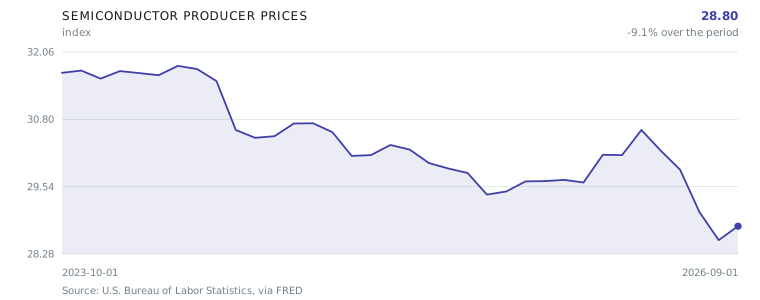
- 01The semiconductor producer price index rose from 28.472 in August 2026 to 28.801 in September 2026.
- 02ixbt and Tom's Hardware describe a sanction swap intended to rescue a critical ASML supplier.
- 03The same reports identify the supplier as a German coatings firm facing shutdown without Chinese rare earths.
- 04The reports rely on China's dominance of vital rare-earth markets.
Interpretation, not reporting. The facts above carry their tiers; this is one correspondent’s reading of them.
The useful lesson is that export controls do not need to hit the champion to hurt the ecosystem. If the reports are right, Europe's problem is not the toolmaker itself but a German coatings firm's access to Chinese rare earths. That moves the risk from abstract trade policy to lead times, inventory buffers and qualification cycles. I would watch for the boring evidence: an EU statement, an ASML disclosure, or a supplier notice. The September producer price index move, from 28.472 to 28.801, is too small and too broad to prove a rare-earth squeeze by itself. It could reflect demand, capacity or ordinary cost pass-through. If official confirmation appears and lead times stretch, the story becomes a physical bottleneck. If it does not, the swap may be a rumour layered onto a modest price increase. Either way, the market is being asked to price a supply chain that is only partly visible.
— Rafael Imai
Every claim in this article, and what it rests on
We do not ask you to take our word for it. Each statement below carries its tier and its sources. Where sources disagree, you get both accounts and what would settle it.
The semiconductor producer price index was 28.472 in August 2026 and 28.801 in September 2026.
The sanction swap is intended to rescue a critical ASML supplier.
The EU is negotiating a sanction swap with China.
The ASML supplier at issue is a German coatings firm.
The German coatings firm faces shutdown without Chinese rare earths.
The EU is prepared to make concessions to China to save the ASML supplier.
China dominates vital rare-earth markets.
The case against this story
Written by an adversarial reviewer, not the correspondent
The story chains together five uncertain links — that the EU is negotiating a 'sanction swap' with China (a term not standard in diplomatic practice), that this swap is intended to rescue an ASML supplier, that the supplier is a German coatings firm, that the firm faces shutdown without Chinese rare earths, and that the EU is prepared to make concessions. Each link depends on the previous one, yet the claim about the negotiation's purpose is rated more confident than the claim that the negotiation exists, which is logically backwards. The semiconductor producer price index figures show a modest 1.15% monthly increase, which does not specifically evidence rare-earth supply disruption or an ASML supplier crisis; rising semiconductor prices have many possible causes. If a critical ASML supplier truly faced shutdown, we would expect official EU statements, ASML regulatory disclosures, or industry announcements — none of which are cited. The story may be conflating separate developments: routine EU-China trade discussions, general rare-earth supply chain concerns, and semiconductor market data.
Who benefits from this framing: China benefits from a framing that portrays it as holding decisive leverage over European semiconductor manufacturing. The German coatings firm benefits if public alarm forces EU intervention or expedited supply arrangements. Advocates for a harder EU stance on China benefit from depicting the EU as prepared to capitulate. Non-Chinese rare-earth mining and processing companies benefit from alarm about Chinese dominance. Short-sellers of ASML or European semiconductor equities benefit from a narrative of supply chain fragility.
Report an error in this article
Subscriptions open at launch
Future Systems Review will be a paid publication. Reading is free while we build the archive — leave an address and we will write to you once, when subscriptions open.