
Record chip earnings meet a fragile price signal
Investors must decide whether the sell-off is a valuation reset or a structural repricing of AI hardware.
 Rafael ImaiCompute, chips and power
A semiconductor producer price index reading of 28.801 sits beside record Korean chip earnings, fund selling in AI-related stocks and an 11% plunge in Indonesia. Buyers have returned to some Asian markets, but China’s growing memory threat raises the stakes. The result is a test of whether the AI-chip trade is correcting or being repriced.
An index that tracks semiconductor producer prices stood at 28.801 on 1 September 2026, while Korean chipmakers reported record earnings and still watched their shares fall. In the same stretch, Indonesia’s equity market plunged 11%, buyers returned to other Asian markets after a sell-off, and investment funds felt selling in AI-related stocks. The question is whether these are separate wobbles or one repricing.
A price signal meets a profit signal
The producer-price figure is a single number, not a trend, and it sits beside evidence that DRAM makers are still profiting. That combination matters because equity markets do not pay for current profit alone; they pay for the durability of that profit. If the price index is signalling softer pricing power while capacity keeps expanding, the market will discount today’s earnings even as they arrive. That is why record results can coincide with falling share prices. Investors are not disputing that money is being made. They are asking whether the margin profile is already turning.
The index does not tell investors whether the move is a one-month distortion or a change in direction. It does tell them that the market now needs proof that record profits are not the last bright part of the cycle.
Korean editorials, including pieces on kmib.co.kr and koreaherald.com, have framed the fall in markets and chip vulnerability as a question of preparedness for a post-boom period. That is not the language of panic. It is the language of a cycle being watched closely. The editorial framing also shows how quickly the mood has shifted from celebrating AI demand to asking what happens when the easiest part of the upcycle ends.
The market is not asking whether chipmakers can earn money; it is asking whether today’s prices already assume too much of tomorrow.
Fund flows are doing the talking
The trading tape adds a second signal. Selling in AI-related stocks hit investment funds, and AI-related fears were cited in Asian equity markets. Yet buyers returned after the sell-off, which argues against a simple crisis reading. A forced exit that finds willing buyers is usually a repricing, not a collapse.
The speed of fund flows can outrun the slower economics of chip supply, which is why a temporary rebound in buying does not fully settle the argument. It shows there are still willing owners, but not that they are convinced the old valuation framework still holds.
Indonesia’s 11% plunge is the outlier. It may reflect local or regional financial conditions rather than semiconductor exposure, and the return of buyers elsewhere suggests that the region’s AI trade has not been abandoned. The stress test is whether these flows remain segmented. If Indonesia stays an isolated case and fund outflows slow, the chip sell-off looks more like a valuation reset. If outflows spread to markets and companies directly tied to AI hardware, the story changes.
The market is not asking whether chipmakers can earn money; it is asking whether today’s prices already assume too much of tomorrow.
China is the variable that could make it structural
The deeper risk is supply. DRAM makers are profiting as China builds a competitive threat. That is the tension: current earnings can be strong while the competitive structure worsens. If new Chinese capacity eventually pressures memory prices, today’s record earnings could become a high-water mark rather than a base.
This is where the producer-price number becomes more than a curiosity. If it foreshadows weaker pricing while Chinese supply rises, the correction could become structural. If it is just noise beside strong earnings and returning buyers, then the trade is simply losing its easy momentum. The next confirmation will come from whether memory pricing, fund flows and Asian market breadth move together or continue to diverge.
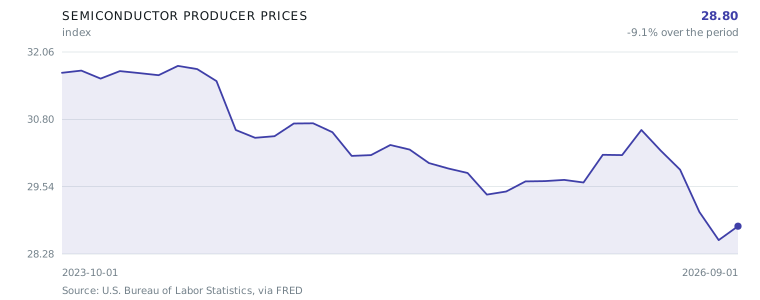
- 01The semiconductor producer price index was 28.801 on 1 September 2026.
- 02Korean semiconductor companies reported record earnings while their share prices fell sharply.
- 03Indonesia’s equity market plunged 11%, while buyers returned to other Asian markets after a sell-off.
- 04Selling in AI-related stocks hit investment funds, and AI-related fears were cited in Asian markets.
- 05DRAM makers are profiting as China builds a competitive threat.
Interpretation, not reporting. The facts above carry their tiers; this is one correspondent’s reading of them.
The pressure on chip shares looks like a duration problem, not a solvency problem. I see record Korean earnings and returning buyers as evidence that the demand cycle has not broken. But the 28.801 producer-price reading, fund outflows and China’s competitive threat point to a narrower margin path than the market appeared to assume. If memory makers keep reporting record profits while their shares fall, investors are treating those profits as late-cycle rather than durable. If Indonesia’s plunge stays contained and AI-related fund selling slows, the repricing probably stops at a correction. If Chinese supply begins to weigh on DRAM pricing while share prices keep diverging from earnings, the market is repricing the whole cycle. The decisive variable is whether price discipline survives the build-out.
— Rafael Imai
Every claim in this article, and what it rests on
We do not ask you to take our word for it. Each statement below carries its tier and its sources. Where sources disagree, you get both accounts and what would settle it.
The semiconductor producer price index was 28.801 on 2026-09-01.
Korean editorials framed falling markets and chip vulnerability as a post-semiconductor-boom preparedness issue.
Selling in AI-related stocks hit investment funds.
Asian equity markets saw buyers return after a sell-off.
Indonesia's equity market plunged 11%.
AI-related fears were cited in Asian equity markets.
Korean semiconductor companies reported record earnings while their share prices fell sharply.
DRAM makers are profiting as China builds a competitive threat.
The case against this story
Written by an adversarial reviewer, not the correspondent
The story stitches together disparate events—Indonesia's market plunge, Korean chip earnings, AI stock selling, and Chinese competition—into a single crisis narrative about semiconductor vulnerability. But the threads don't hold together. Indonesia is not a major semiconductor market, so its 11% plunge likely reflects domestic or regional financial factors unrelated to AI or chips. The claim that buyers returned to Asian markets directly undercuts the crisis framing by showing the sell-off was temporary. Korean semiconductor companies reporting record earnings is fundamentally a positive signal that contradicts the vulnerability narrative—falling share prices amid record profits is a valuation correction, not a structural crisis. The specific producer price index figure of 28.801 is anomalously low for a PPI and suspiciously precise, raising the possibility it is misread or fabricated. The editorial framing claim is an interpretation without a named source. The overall picture cherry-picks negative signals (falling prices, fear, China threat) while ignoring contradictory evidence (record earnings, buyers returning, ongoing profitability), producing a crisis narrative that the underlying data does not sustain.
Who benefits from this framing: Short sellers of Korean semiconductor stocks profit directly from fear-driven price declines. Chinese semiconductor competitors (such as CXMT or SMIC) benefit from negative sentiment toward Korean rivals, as it weakens investor confidence in the very companies China is trying to displace. Proponents of expanded semiconductor industrial policy—governments seeking to justify further CHIPS-Act-style subsidies or export controls—benefit from a crisis framing that makes government intervention seem urgent and necessary. Bargain-hunting institutional investors benefit from retail panic selling, allowing them to accumulate semiconductor positions at depressed prices before the record-earnings reality reasserts itself in valuations.
Report an error in this article
Subscriptions open at launch
Future Systems Review will be a paid publication. Reading is free while we build the archive — leave an address and we will write to you once, when subscriptions open.