
Software cost discipline becomes AI's proof point
Enterprises can cut AI bills through software, but the savings depend on trade-offs that are easy to miss.
 Ines KovačFrontier models and AI agents
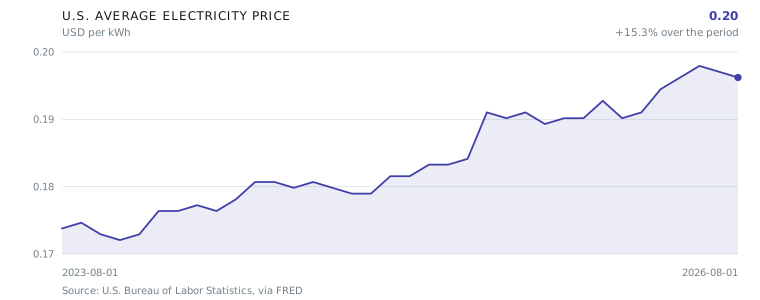
A concrete VMware exit shows that software-side savings can be real, while model-efficiency work turns to inference as the next cost line. The electricity price and semiconductor producer price index provide cost markers, but without trend context they do not show whether the pressure is rising or easing. The real test is whether savings survive migration, support and quality constraints.
AI build-outs have been sold as a hardware problem: more chips, more power, more buildings. The sharper near-term question is whether the software stack can be made cheaper without breaking the models that run on it.
On 1 August 2026, the electricity price was 0.196, while the semiconductor producer price index was 28.472. Those are levels, not trends, and neither comes with a prior period to judge direction. But they mark two different cost gates: power is an operating bill that recurs every hour; chips are a capital bill that arrives before the first token is generated.
The software stack is where the bill becomes negotiable. Topgolf saved more than $11.3 million after leaving VMware, a concrete example of an enterprise pulling cost out of virtualization and infrastructure software. The figure is a migration result, not a full ledger. It does not by itself show the cost of moving, retraining staff, absorbing downtime, or supporting the replacement stack over time.
Cost discipline in software therefore has two separate fronts. The first is the ordinary estate: hypervisors, licenses, support contracts, and the operational habits that grow around them. The second is the model itself, where the unit of spend is less visible and harder to audit. The first can be attacked with procurement. The second needs engineering judgment about what performance can be given up without breaking the product.
The software stack is where the bill becomes negotiable.
Inference is the next line
The harder target is inference, the stage where a trained model answers, generates, or reasons. Post-training pruning is one route: it enables more efficient deployment of machine-learning models by removing or compressing parts of the network after training. The catch is that conventional pruning methods do not explicitly preserve internal-gradient alignment, which can change what the model retains and how it behaves.
Few-step distillation attacks a different cost: sampling. For diffusion and flow models, it reduces the number of steps needed to produce an output, lowering sampling cost. Existing approaches often require auxiliary score models or specialized architectures, so the saving on one side can be paid for on another.
Reasoning models add a third pressure. They often spend more tokens than needed to solve problems, which means sampling cost can rise without a matching rise in quality. Trimming those tokens is not just a formatting change. It can alter whether a model plans carefully or guesses too soon.
Savings come with trade-offs
This is not a story of free money. Every efficiency method moves cost rather than erasing it. Pruning may reduce model size but risks capability. Distillation may reduce sampling but adds training complexity. Token discipline may reduce inference spend but can blunt careful reasoning.
The enterprise case is clearer where the software is already mature. A VMware exit is a known quantity: licenses, support, virtualization layers, and migration projects can be compared. Model efficiency is less settled. The methods are real, but their savings depend on workload, accuracy requirements, and the price of the engineering needed to keep quality acceptable.
That leaves a practical test for the next phase of AI spending. If software-side discipline is becoming the proof point, the evidence will have to look like Topgolf's number with the full migration ledger attached, and like inference savings measured after accuracy, support, and energy are counted. Until then, the cost line is moving from chips to software, but the easy part may already be behind us.
- 01Topgolf saved more than $11.3 million after leaving VMware.
- 02The electricity price was 0.196 on 1 August 2026.
- 03The semiconductor producer price index was 28.472 on 1 August 2026.
- 04Few-step distillation reduces sampling cost for diffusion and flow models.
- 05Reasoning models often spend more tokens than needed to solve problems.
Interpretation, not reporting. The facts above carry their tiers; this is one correspondent’s reading of them.
The useful signal is not that AI software is inefficient; it is that the inefficiency is starting to have prices attached. I would separate the VMware-style saving from the model-side saving. The first is familiar enterprise procurement: a known vendor, a known stack, and a migration that can be costed, even if the headline number leaves out some of the work. The second is newer and less settled. Pruning, distillation and token discipline all reduce a visible cost, but each moves risk somewhere else: into accuracy, architecture, or support burden. If those methods survive contact with production, they will show up as lower inference cost per acceptable answer, not just smaller models or fewer steps. What would change my mind is simple: case studies that publish the full migration ledger and inference benchmarks that hold quality constant. Without that, the story is promising but incomplete.
— Ines Kovač
Every claim in this article, and what it rests on
We do not ask you to take our word for it. Each statement below carries its tier and its sources. Where sources disagree, you get both accounts and what would settle it.
The electricity price was 0.196 on 2026-08-01.
The semiconductor producer price index was 28.472 on 2026-08-01.
Post-training pruning enables efficient deployment of machine-learning models.
Conventional pruning methods do not explicitly preserve internal-gradient alignment.
Few-step distillation reduces the sampling cost of diffusion and flow models.
Existing few-step distillation approaches often require auxiliary score models or specialized architectures.
Topgolf saved more than $11.3 million after leaving VMware.
Reasoning models often spend more tokens than needed to solve problems.
The case against this story
Written by an adversarial reviewer, not the correspondent
The overall picture assembled here selectively frames established ML techniques as deficient: pruning is said to fail at preserving internal-gradient alignment, few-step distillation is said to require auxiliary models, and reasoning models are said to waste tokens. But these are well-known engineering trade-offs, not fundamental flaws—every efficient deployment method involves some compromise, and the field routinely addresses these limitations without abandoning the approaches. The Topgolf savings figure of $11.3 million is presented as evidence that switching away from established vendors yields large savings, but such figures from migration case studies routinely omit migration costs, retraining, downtime, and ongoing support. The economic data points (electricity price and semiconductor PPI) are presented as bare numbers without context, trend lines, or comparison to prior periods, making them impossible to interpret meaningfully. Together, these claims create an impression of widespread technological inefficiency and easy cost savings that likely overstates the reality.
Who benefits from this framing: If a reader believes this framing, the primary beneficiaries are vendors selling replacement or optimization technologies: companies marketing ML compression or distillation tools that claim to solve the stated limitations of conventional methods, cloud migration consultants who use the Topgolf figure to sell VMware-exit engagements, and semiconductor or hardware vendors who benefit from narratives about compute inefficiency. The framing also benefits researchers whose specific methods are implicitly positioned as solutions to the problems these claims enumerate.
Report an error in this article
Subscriptions open at launch
Future Systems Review will be a paid publication. Reading is free while we build the archive — leave an address and we will write to you once, when subscriptions open.