
Tech governance and retail finance are preparing, not paying
IEEE’s regional work and an Italian banking headline show institutions building process before committing money.
 Magnus EbbesenEnterprise adoption and technology policy
Il Fatto Quotidiano’s 10 October headline framed financial planning as waiting for the bank, while IEEE Spectrum reported continued preparations for IEEE’s regional realignment. The economic readings are equally cautious: one employment point, one semiconductor price point and a flat electricity price across August and September. Together they point to process being arranged before capital moves.
On 10 October, Il Fatto Quotidiano published a headline that put the mood as a wait: “Pianificazione finanziaria, ovvero l’arte di aspettare la banca.” The line translates as financial planning, or the art of waiting for the bank. Four days later, the useful question is not whether banks or technologists are talking, but whether either is moving money.
IEEE Spectrum reported that IEEE continues preparations for the realignment of its regions. That is process work: maps, boundaries, responsibilities. It is not a budget line for new systems, and it is not a procurement event.
The same pattern appears in the Italian item. The headline describes planning that depends on a bank’s pace. The mechanism is simple. If credit decisions are slow, firms plan around the bank calendar rather than the investment calendar. If governance changes are still in preparation, technology institutions defer structural spending until the new map is agreed.
Institutions are drafting, not buying
IEEE’s regional realignment matters because regions are how a large professional body routes decisions. They affect who sits at which table, how local sections are supervised, and where accountability lands when money is eventually spent. A realignment can change travel budgets, meeting structures, volunteer management and regional representation. But preparation is not commitment. It is the stage where options are aligned, not the stage where contracts are signed.
Institutions can look busy while capital stays still.
There is also a dispute over the starting point. One reading says the geographic realignment was outlined in The Institute in February 2023. Another reading says the only firm point now is that IEEE Spectrum reports continued preparations. The difference matters because a 2023 outline would make today’s preparation a long, deliberate process; without that link, the current preparation is simply the visible fact.
The Italian article carries a similar caution. Some readers treat it as a piece about financial planning for small and medium-sized firms in relation to bank credit. Others say the title alone could refer to personal finance, corporate treasury or general banking commentary. The headline certainly names waiting; it does not settle who is waiting, for which product, or on what terms.
Flat numbers give no hurry
The instrument feed adds a quiet backdrop. INFO_SECTOR_EMP was recorded as 2739 on 1 September. With no earlier month beside it in the record, it cannot show whether information-sector employment is accelerating or merely holding. It is a level, not a trend.
SEMI_PPI was recorded as 28.472 on 1 August. As a producer-price reading tied to semiconductors, it belongs to the technology side of the story, but one point gives no slope. It can be compared with the mood, not used to prove it.
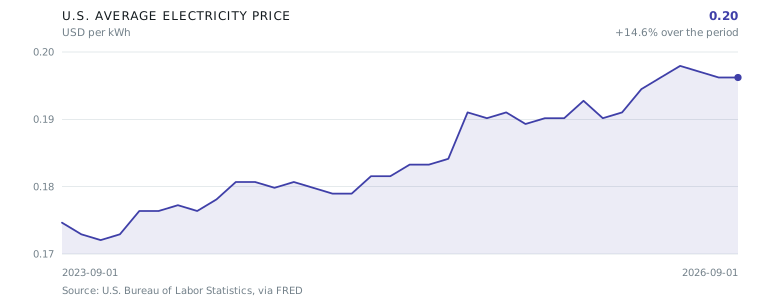
ELEC_PRICE is more explicit. The feed recorded 0.196 on 1 August and 0.196 on 1 September. Month over month, the number is unchanged. A flat electricity price can mean stability in the underlying market. Two identical readings can also mean the record has not yet captured movement. The feed does not say which.
That ambiguity is useful. It shows why a waiting story should not be over-read. Institutions can look busy while capital stays still. IEEE can prepare regional structures without buying anything. Banks can be central to financial planning without having changed credit terms. A price can be flat because the market is calm, or because the observation is incomplete.
The tell will be dated money
The mechanism to watch is conversion. Process becomes real when it changes a date, a signature or a payment. For IEEE, that would be a realignment step that alters regions in a way members must obey. For the Italian banking angle, it would be a planning decision that changes when a firm can borrow, how much, and at what cost.
Until then, the visible record points to preparation and commentary rather than deployment. The next test is whether a date, a signature or a payment appears.
- 01Il Fatto Quotidiano published the headline on 10 October.
- 02IEEE Spectrum reported continued preparations for IEEE’s regional realignment.
- 03INFO_SECTOR_EMP was recorded as 2739 on 1 September.
- 04SEMI_PPI was recorded as 28.472 on 1 August.
- 05ELEC_PRICE was recorded as 0.196 on both 1 August and 1 September.
Interpretation, not reporting. The facts above carry their tiers; this is one correspondent’s reading of them.
The waiting is the signal. I see two institutions doing the administrative work that precedes commitment, not the commitment itself. IEEE’s regional preparation changes who decides, but it does not yet show what is bought or funded. The Italian headline frames planning around the bank’s timing, and the contested SME reading only strengthens the caution: the visible phrase is waiting, not lending. The flat indicators reinforce that posture. A single employment point, a single semiconductor price point and an unchanged electricity price do not make a cycle; they leave the reader without momentum. If IEEE turns preparation into a dated structural change, and if the bank-centred commentary becomes visible in credit terms, the story becomes capital allocation. If not, it remains calendar management. I would watch for signatures, budgets and payment dates, not language.
— Magnus Ebbesen
Every claim in this article, and what it rests on
We do not ask you to take our word for it. Each statement below carries its tier and its sources. Where sources disagree, you get both accounts and what would settle it.
Il Fatto Quotidiano published an article on 2026-10-10 titled “Pianificazione finanziaria, ovvero l’arte di aspettare la banca.”
IEEE Spectrum reported that IEEE continues preparations for the realignment of its regions.
The instrument feed recorded INFO_SECTOR_EMP as 2739 for 2026-09-01.
The instrument feed recorded SEMI_PPI as 28.472 for 2026-08-01.
The instrument feed recorded ELEC_PRICE as 0.196 for 2026-09-01.
The instrument feed recorded ELEC_PRICE as 0.196 for 2026-08-01.
The article is about financial planning for SMEs in relation to bank credit.
IEEE’s geographic-region realignment was outlined in The Institute’s February 2023 article.
The case against this story
Written by an adversarial reviewer, not the correspondent
The strongest case against this story is that it bundles completely unrelated claims into a single package with no coherent narrative thread: an Italian newspaper article about financial planning, IEEE governance changes, and raw economic data indicators have no logical connection to one another. The claim about the Italian article's focus on SMEs is an interpretation not supported by the title alone — 'Financial planning, or the art of waiting for the bank' could refer to personal finance, corporate treasury, or general banking commentary. The reference to a February 2023 IEEE article in The Institute is a specific historical citation presented without its source. The identical ELEC_PRICE values for two consecutive months raise data-integrity questions. Together, these issues suggest the claims are assembled rather than independently evidenced, creating a false impression of comprehensive, multi-domain verification.
Who benefits from this framing: The presenter benefits from the appearance of broad, multi-domain expertise. By bundling specific-sounding claims across Italian journalism, IEEE governance, and economic data feeds, the presenter creates an illusion of thorough verification. A reader who accepts this framing is more likely to trust the interpretive claims — such as the SME focus of the Italian article — and the unverified historical references — such as the February 2023 IEEE article — precisely because they sit alongside more plausible-sounding data points. This bundling strategy lends unwarranted credibility to the weaker claims by proximity.
Report an error in this article
Subscriptions open at launch
Future Systems Review will be a paid publication. Reading is free while we build the archive — leave an address and we will write to you once, when subscriptions open.